
“Will my insurance pay for this?” is often the second question my patients ask about stimulation, right after “Will it help?” It’s a fair question, and the honest answer is that spinal cord stimulator insurance coverage is common for appropriate patients but rarely automatic. Medicare and most private plans recognize spinal cord stimulation as an established therapy for certain chronic pain conditions, yet nearly all of them attach requirements. In this guide, I’ll explain how coverage generally works, what insurers typically look for, and how to prepare so the process goes as smoothly as possible.
A quick note before we begin: I’m a neurosurgeon, not an insurance professional, and every plan is different. Treat this as a general orientation, and confirm the specifics of your own policy with your insurer and your care team’s authorization staff.
Is Spinal Cord Stimulation Considered Standard Care?
Spinal cord stimulation has been used for decades, and it is widely regarded as an established treatment for selected chronic pain conditions — not an experimental one. That status is the foundation of spinal cord stimulator insurance coverage. Conditions that insurers commonly recognize include persistent pain after spine surgery, complex regional pain syndrome, and certain types of chronic nerve-related pain in the back and legs. In recent years, some systems have also been approved for painful diabetic neuropathy.
If you’re living with one of these conditions, you may find my articles on failed back surgery syndrome treatment and CRPS and neuromodulation helpful background.
How Medicare Approaches Spinal Cord Stimulator Insurance Coverage
Medicare has a national coverage policy for implanted nerve stimulators used to treat chronic, intractable pain. In general terms, Medicare expects that:
- Other appropriate treatments have been tried and have not provided adequate relief, or are not suitable.
- The patient has been carefully screened, evaluated, and diagnosed by a multidisciplinary team, which commonly includes a psychological evaluation.
- The procedure is performed by appropriately trained physicians, with facilities and staff to provide follow-up care.
- A successful trial has demonstrated that stimulation is likely to help before a permanent system is implanted.
Original Medicare and Medicare Advantage plans can handle the details differently. Medicare Advantage plans are run by private companies and often require prior authorization and use their own provider networks. Your share of the cost depends on your plan, including deductibles, coinsurance, and any supplemental coverage you carry. The MedlinePlus Medicare resource page is a reliable starting point for understanding the different parts of Medicare.
How Private Plans Typically Handle Coverage
Commercial insurers — whether through an employer, a marketplace plan, or another source — usually publish medical policies describing when they consider spinal cord stimulation medically necessary. These policies vary, but they tend to share common themes with Medicare’s approach:
- Documented diagnosis. A condition the plan recognizes as appropriate for stimulation.
- Duration of pain. Chronic pain that has persisted over a meaningful period of time.
- Conservative care first. Records showing that reasonable treatments — such as physical therapy, medications, and injections where appropriate — were tried.
- Psychological evaluation. Screening to make sure factors like untreated depression or anxiety are addressed, since they can affect outcomes.
- A successful trial. Meaningful improvement during a temporary trial before the permanent implant is approved.
- Prior authorization. Approval obtained in advance, often separately for the trial and for the permanent implant.
Many plans also review whether there is a surgical problem that should be corrected first, and whether there are any medical reasons stimulation might be unsafe. Each of these is reasonable; together, they make the case that stimulation is the right next step.
Wondering where you stand?
A consultation is the first step toward a clear, documented plan.
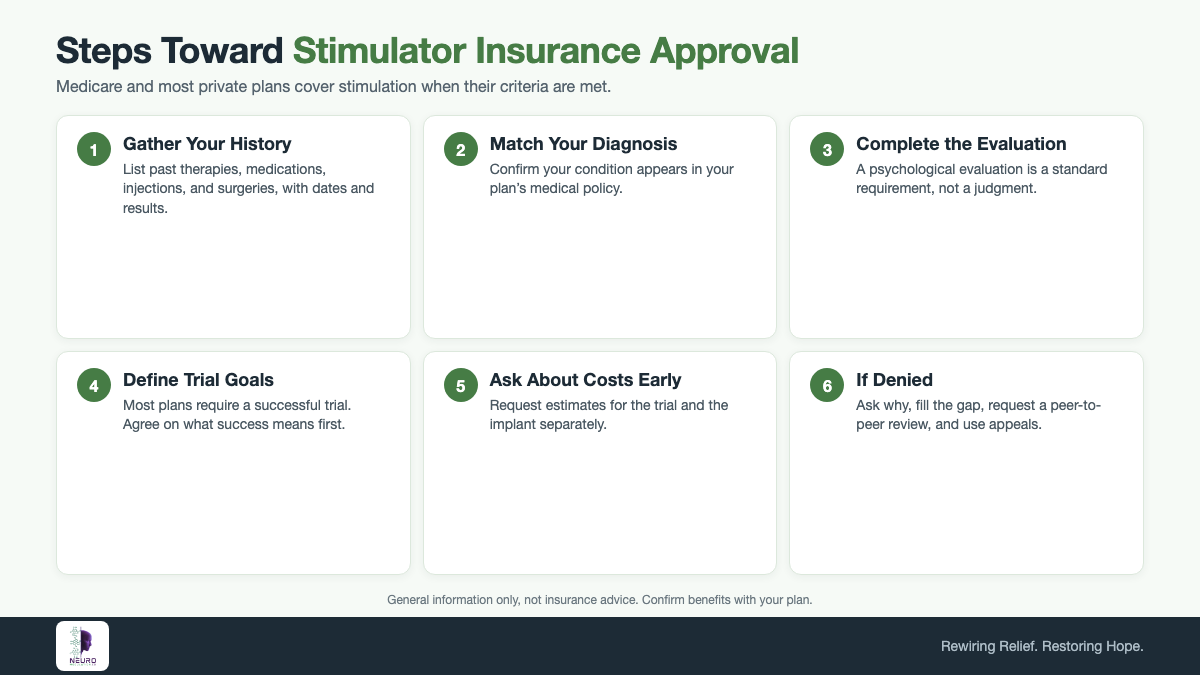
Five Steps to Prepare for the Approval Process
The requirements above can sound like hurdles, but in my experience they mostly mirror good medicine. Here’s how to put yourself in the best position for spinal cord stimulator insurance coverage.
1. Gather your treatment history
Insurers want to see what you’ve tried and how it went. Make a simple list of past treatments — physical therapy, medications, injections, surgeries — with approximate dates and results. Request records from previous physicians if they’re scattered across practices. Complete, organized history often speeds the process.
2. Understand your diagnosis in your plan’s terms
Ask your physician which diagnosis will be submitted and whether it matches the conditions listed in your plan’s medical policy. If you’re unsure whether you meet the clinical criteria, my checklist, Am I a Candidate for a Spinal Cord Stimulator?, walks through what physicians typically look for.
3. Complete the psychological evaluation
Some patients worry that this evaluation means their pain isn’t believed. It doesn’t. It’s a standard part of the pathway, it helps identify support that could improve your outcome, and it’s required by many plans. Approach it openly.
4. Plan your trial with clear goals
Because most insurers require a successful trial, define what “success” means before it starts — pain relief, but also sleep, walking, standing, and activities you want back. Clear documentation of those results supports the request for a permanent implant. I describe the process in detail in The Spinal Cord Stimulator Trial: What Actually Happens, Step by Step.
5. Ask about your financial responsibility early
Even with approval, you may owe deductibles, copays, or coinsurance. Ask the office who handles prior authorization and whether they can estimate your out-of-pocket responsibility for the trial and the implant separately. Ask your insurer, too, and request answers in writing when possible.
What Coverage Usually Includes
When a plan approves stimulation, coverage generally extends across the whole episode of care, though the details vary. Expect to see separate pieces such as the consultation and evaluation, the trial procedure, the permanent implant, the device itself, facility fees, anesthesia, and follow-up programming visits. Many plans also cover future battery replacement and medically necessary revisions, subject to their own review.
Because each of these can carry its own cost-sharing, I encourage patients to ask how the bills will be structured. Understanding that ahead of time prevents surprises later. It’s also worth asking whether the device manufacturer offers a patient support program for benefits questions; some do, and they can be a helpful second set of eyes on the paperwork alongside your physician’s office.
Questions to Ask Your Insurer Before You Start
A short phone call to your insurer before the trial can save weeks of uncertainty later. Have your member ID ready, write down the date and the representative’s name, and ask for reference numbers. These are the questions I suggest patients bring:
- Does my plan have a published medical policy on spinal cord stimulation, and can you send me a copy?
- Is prior authorization required for the trial, the permanent implant, or both?
- Are my physician and the facility where the procedure will be done in network?
- How do my deductible, copays, and coinsurance apply to the trial and to the implant?
- Have I met any of my deductible or out-of-pocket maximum this plan year?
- Are follow-up programming visits and future generator replacements covered under the same benefit?
Keep your notes with your medical records. If anything you’re told conflicts with what the physician’s office hears, those notes become very useful.
When your plan changes
Spinal cord stimulator insurance coverage is tied to the plan you have when each service happens, not the plan you had when you started the process. If you’re changing jobs, aging into Medicare, or switching plans during open enrollment, let your care team know right away. A new plan may need a fresh authorization, a different network, or additional documentation. Timing a trial and implant within a single plan year can simplify things, though medical readiness should always come first. Similarly, if you already have a device and change plans, ask early how your new insurer handles programming visits and eventual battery replacement, so there are no surprises when you need either. A little planning here protects your spinal cord stimulator insurance coverage over the long life of the device.
If Your Request Is Denied
A denial is not always the final word. Denials sometimes occur because of missing documentation, a coding issue, or a requirement that hasn’t yet been met. Here’s what often helps:
- Find out why. Ask for the specific reason in writing and the exact policy criteria the plan applied.
- Fill the gap. If records were missing or a step wasn’t documented, your care team may be able to supply it and resubmit.
- Request a peer-to-peer review. Many plans allow your physician to discuss the case directly with the insurer’s medical reviewer.
- Use the appeals process. Plans have formal appeal procedures, and Medicare has its own appeals process. Note the deadlines carefully.
Patience and organization matter here. Spinal cord stimulator insurance coverage decisions are frequently reconsidered when the clinical picture is presented clearly.

Frequently Asked Questions
Does Medicare offer spinal cord stimulator insurance coverage?
Medicare generally covers spinal cord stimulation for chronic, intractable pain when its criteria are met, including prior treatment, careful evaluation, and a successful trial. Your out-of-pocket share depends on your specific Medicare coverage.
Do I need prior authorization for a stimulator trial?
Many plans require prior authorization for the trial and again for the permanent implant. Your physician’s office usually submits these requests, but it’s wise to confirm with your insurer.
Why do insurers require a psychological evaluation?
Chronic pain affects mood, sleep, and coping, and those factors can influence how well stimulation works. The evaluation helps make sure you have the right support. It’s a standard requirement, not a judgment about your pain.
Will insurance cover a battery replacement later?
Many plans cover medically necessary generator replacements, subject to their review at the time. Coverage can change if you switch plans, so it’s worth checking whenever your insurance changes.
The Bottom Line
Spinal cord stimulator insurance coverage is widely available for patients who meet established criteria, but it rewards preparation. Organize your treatment history, understand your diagnosis in your plan’s terms, complete the evaluation, define clear trial goals, and ask about costs early. If you’d like a more complete list of what to discuss at your visit, see 9 Questions to Ask Your Doctor Before a Stimulator Trial. With a thoughtful team and good documentation, the paperwork usually becomes a manageable part of the journey rather than a barrier to it.
— Dr. Erika Petersen, MD, FAANS, FACS, is a board-certified neurosurgeon specializing in neuromodulation and a past president of the American Society of Pain & Neuroscience. Connect with her on LinkedIn.
This article is educational only and is not medical or insurance advice. Coverage rules vary by plan and change over time; confirm your benefits directly with your insurer. Individual results vary, and nothing here replaces an in-person evaluation with a licensed physician.
Considering a stimulator trial?
Schedule a consultation and get answers specific to your situation.