
Few conversations in my clinic carry as much weight as the one that begins, “I had the surgery, and I still hurt.” If that’s you, I want to start by saying clearly: persistent pain after spine surgery is common, it is not your fault, and it is not the end of the road. Failed back surgery syndrome treatment has changed meaningfully over the past two decades, and neuromodulation — spinal cord stimulation in particular — is one of the best-studied options for exactly this situation. As a neurosurgeon who specializes in neuromodulation, I’d like to walk you through what the diagnosis means, what your options are, and why stimulation so often becomes part of the plan.
Our condition page on failed back surgery syndrome (FBSS) covers the clinical background. This article is about the practical question that follows: what can actually be done now?
What “Failed Back Surgery Syndrome” Really Means
The name is unfortunate, and many physicians, myself included, wish it would retire. It suggests that someone failed — the surgeon, the patient, or the operation. In reality, the term simply describes persistent or recurrent back and/or leg pain after one or more spine surgeries. The surgery may have achieved exactly what it was designed to do on imaging, and pain can persist anyway. You’ll increasingly see newer terminology such as “persistent spinal pain syndrome,” which describes the problem without assigning blame.
Why does pain persist? The reasons vary from person to person, and often more than one is at play:
- Nerve injury or irritation that predated the surgery and didn’t fully recover once pressure was relieved.
- Scar tissue (epidural fibrosis) forming around nerve roots as part of normal healing.
- Recurrent disc herniation at the same level.
- Adjacent segment changes, where levels above or below a fusion take on extra stress over time.
- Persistent instability or narrowing that wasn’t fully addressed, or developed later.
- Pain generators outside the operated level — the sacroiliac joint, facet joints, or muscles.
- Central sensitization, in which a nervous system exposed to pain for years becomes more reactive to pain signals.
Sorting out which of these applies to you is the first job of good failed back surgery syndrome treatment, because the answer shapes everything that follows.
Step One: A Fresh, Careful Evaluation
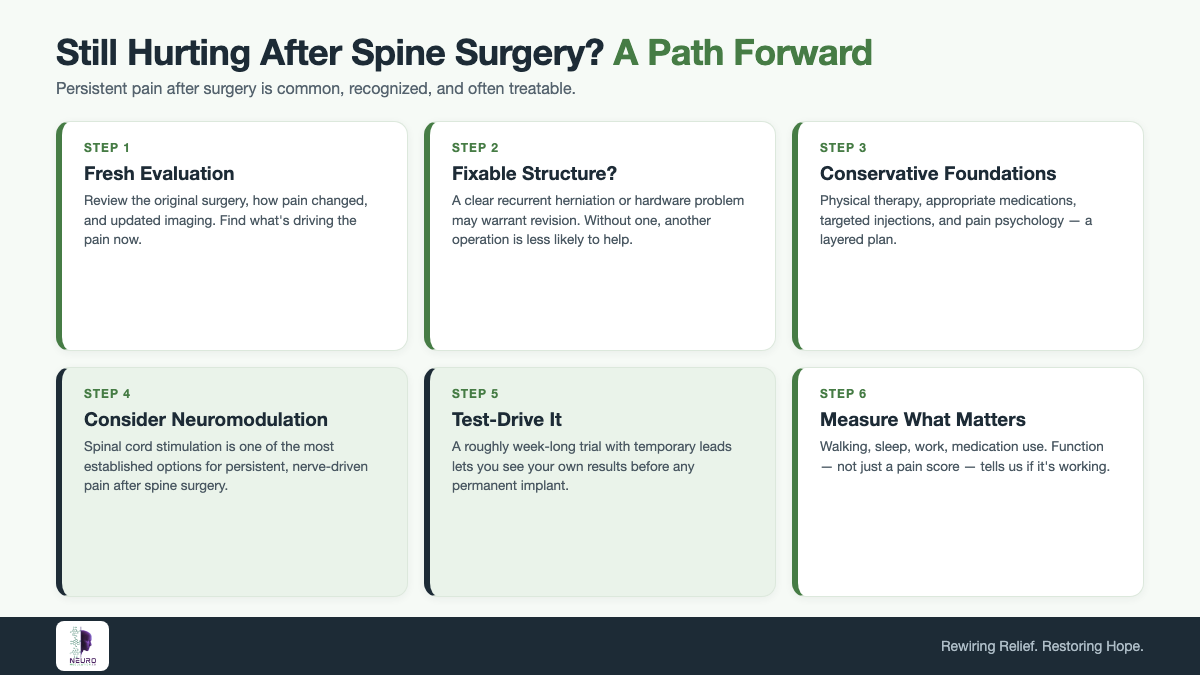
When a patient comes to me after spine surgery, I start over. I review the original reason for surgery, the operative details, how the pain changed afterward, and what it’s like today. Leg pain that burns or tingles behaves differently from deep mechanical back pain that worsens with movement. Updated imaging is often useful, and occasionally diagnostic injections help pinpoint the source.
That evaluation answers a critical question: is there a structural problem that another operation could genuinely fix? Sometimes the answer is yes — a clear recurrent herniation compressing a nerve, for example, or hardware that has failed. In those cases, revision surgery may be appropriate. But when imaging doesn’t show a correctable problem, or when the pain is primarily nerve-driven, another operation on the same anatomy is less likely to help, and the conversation turns to other tools.
Still in pain after spine surgery?
A fresh evaluation is the starting point for a better plan.
The Failed Back Surgery Syndrome Treatment Toolbox
Effective failed back surgery syndrome treatment is rarely a single intervention. It’s usually a layered plan, and stimulation often works best alongside other strategies rather than instead of them. The main categories include:
- Physical therapy and graded activity. Rebuilding strength, flexibility, and confidence in movement remains foundational, even when it can’t solve the problem alone.
- Medications. Anti-inflammatories, nerve-pain medications, and others may help some patients. Long-term opioid therapy carries well-known risks and is increasingly approached with caution.
- Interventional procedures. Epidural injections, nerve blocks, and radiofrequency ablation can target specific pain generators.
- Psychological support. Pain psychology, cognitive behavioral therapy, and sleep care are evidence-based tools, not a suggestion that pain is “in your head.”
- Revision surgery when there is a clear, correctable structural cause.
- Neuromodulation, most commonly spinal cord stimulation, when pain persists despite reasonable conservative care.
No single item on that list is a magic answer, and the order matters. I generally want to see that the conservative foundations have been given a fair chance before moving to an implanted device, and I want stimulation, if we use it, to make the rest of the plan work better — more productive physical therapy, better sleep, a more active life. In my experience, failed back surgery syndrome treatment succeeds most often when the patient, the surgeon, the therapist, and the primary care physician are all pulling in the same direction.
Why Neuromodulation Fits Failed Back Surgery Syndrome So Well
Persistent pain after spine surgery is one of the most established reasons spinal cord stimulation exists today. It’s been studied in this population for decades, including randomized trials that compared stimulation with repeat surgery and with conventional medical management alone. Those studies, along with long clinical experience, are a major reason professional guidelines and insurers recognize stimulation as an appropriate option for well-selected patients with this condition.
The logic is straightforward. Much of the pain in this situation is neuropathic — generated or amplified by irritated, injured nerves. Spinal cord stimulation works on the nervous system itself, modulating how pain signals travel toward the brain rather than trying to change the anatomy again. I explain the mechanism in detail in Spinal Cord Stimulation: How It Works and Who It Helps.
Historically, stimulation was strongest for leg pain and less reliable for axial low back pain. Newer stimulation patterns and programming approaches have broadened what’s possible for back pain as well, though results vary from person to person. For pain concentrated in a very specific region, such as one foot or the groin, targeted approaches discussed in my comparison of DRG stimulation vs. spinal cord stimulation may be worth considering.
The Trial: Test Before You Commit
One of the greatest strengths of neuromodulation as a failed back surgery syndrome treatment is that you don’t have to take it on faith. Before any permanent implant, you complete a trial: temporary leads placed through a needle, connected to an external stimulator, and worn for about a week of real life at home. You track your pain, sleep, function, and medication use. If the trial clearly helps, a permanent system is discussed. If it doesn’t, the leads come out in minutes and nothing was implanted.
For patients who have already been through one or more operations that didn’t deliver what they’d hoped, this matters enormously. It’s a chance to see your own evidence before committing to another procedure. I walk through each stage in The Spinal Cord Stimulator Trial: What Actually Happens, Step by Step.
Who Is a Good Candidate — and Who Isn’t
Neuromodulation isn’t right for everyone with persistent post-surgical pain. In general, the patients who tend to do best:
- Have pain that has persisted despite reasonable conservative treatment.
- Do not have a clear structural problem that another surgery would reliably correct.
- Have a meaningful neuropathic component to their pain, such as radiating leg pain.
- Have realistic goals focused on function — walking, sleeping, working — rather than expecting zero pain.
- Have had a psychological evaluation, with any untreated depression or anxiety addressed.
- Are willing to participate actively in programming visits and rehabilitation.
Active infection, uncontrolled bleeding problems, or certain other medical conditions may rule it out or delay it. My full checklist is in Am I a Candidate for a Spinal Cord Stimulator?
Wondering if stimulation could help you?
We’ll review your surgical history and talk through every option honestly.
Honest Expectations About Results and Risks
I won’t promise anyone a cure. What I can say is that many well-selected patients report meaningful pain relief and improvements in function, sleep, and quality of life with spinal cord stimulation — and that a successful trial is the best predictor we have. Some patients reduce their reliance on pain medication; others use stimulation to make physical therapy and daily activity possible again.
The risks are real but generally manageable: infection, lead movement that requires reprogramming or revision, discomfort at the generator site, and, rarely, more serious complications such as bleeding or nerve injury. Devices also require long-term care — programming visits, charging for rechargeable systems, and eventual battery replacement. The National Institute of Neurological Disorders and Stroke provides useful background on chronic pain and its treatment at ninds.nih.gov.
What Life Can Look Like Afterward
For patients who move forward with a permanent system, the first couple of months involve temporary activity restrictions while the leads settle, followed by a gradual return to normal life and periodic programming visits. Many patients use that window to rebuild strength with a therapist. The goal I set with each patient is concrete: a longer walk, an uninterrupted night of sleep, a return to work or a hobby that pain took away. When we measure failed back surgery syndrome treatment by those everyday gains rather than a single number on a pain scale, both of us get a far more honest picture of whether it’s working.

Frequently Asked Questions
What is the best failed back surgery syndrome treatment?
There isn’t one best treatment for everyone. The right plan depends on what’s driving your pain. When a correctable structural problem exists, revision surgery may help. When pain is primarily nerve-related and persists despite conservative care, spinal cord stimulation is one of the most established options, usually combined with physical therapy and other supportive care.
Should I have another back surgery?
Only if there’s a clear, specific problem that another operation is likely to fix. Without one, repeat surgery on the same area tends to have diminishing returns. A careful evaluation, ideally including a surgeon familiar with both revision surgery and neuromodulation, helps sort this out.
Can a spinal cord stimulator help back pain, or only leg pain?
Traditionally it was most reliable for leg pain, but newer stimulation patterns have improved outcomes for back pain in many patients. Results vary, which is exactly why the trial week exists.
Is it too late if my surgery was years ago?
Not necessarily. Many patients are evaluated years after their surgery. That said, long-standing pain can sensitize the nervous system, so there’s value in exploring options rather than waiting indefinitely.
The Bottom Line
Persistent pain after spine surgery is a real, recognized condition — and a treatable one for many patients. Good failed back surgery syndrome treatment starts with a fresh evaluation, uses every appropriate tool, and gives neuromodulation serious consideration when nerve-driven pain persists. Best of all, the trial lets you test that second chance before you commit to it.
— Dr. Erika Petersen, MD, FAANS, FACS, is a board-certified neurosurgeon specializing in neuromodulation and a past president of the American Society of Pain & Neuroscience. Connect with her on LinkedIn.
This article is educational only and is not medical advice. Individual results vary, and nothing here replaces an in-person evaluation with a licensed physician. Please consult your own healthcare provider about your specific situation.
Ready for a second opinion on your back pain?
Schedule a consultation and get answers specific to your situation.