
Figuring out whether you’re a spinal cord stimulator candidate is one of the most common reasons patients land in my office — often after years of treatments that helped a little, for a while, and then didn’t. As a board-certified neurosurgeon who has spent my career in neuromodulation — I’m Dr. Erika Petersen, I can tell you the question deserves a more careful answer than a brochure checklist. But there are recognizable signs, patterns I see again and again in the patients who ultimately do well with this therapy.
Below are seven of them. None of these signs by itself makes you a spinal cord stimulator candidate — candidacy is always an individualized medical determination — but if several of them describe your situation, it may genuinely be time to have the conversation.
What Makes Someone a Spinal Cord Stimulator Candidate?
First, a quick orientation. A spinal cord stimulator is a small implanted device that delivers mild electrical pulses near the spinal cord to quiet pain signals before they reach the brain — I explain the full mechanics in Spinal Cord Stimulation: How It Works and Who It Helps. Broadly, a good spinal cord stimulator candidate is someone whose chronic pain is nerve-driven, has persisted despite appropriate conservative care, and who is medically and psychologically prepared for an implanted therapy.
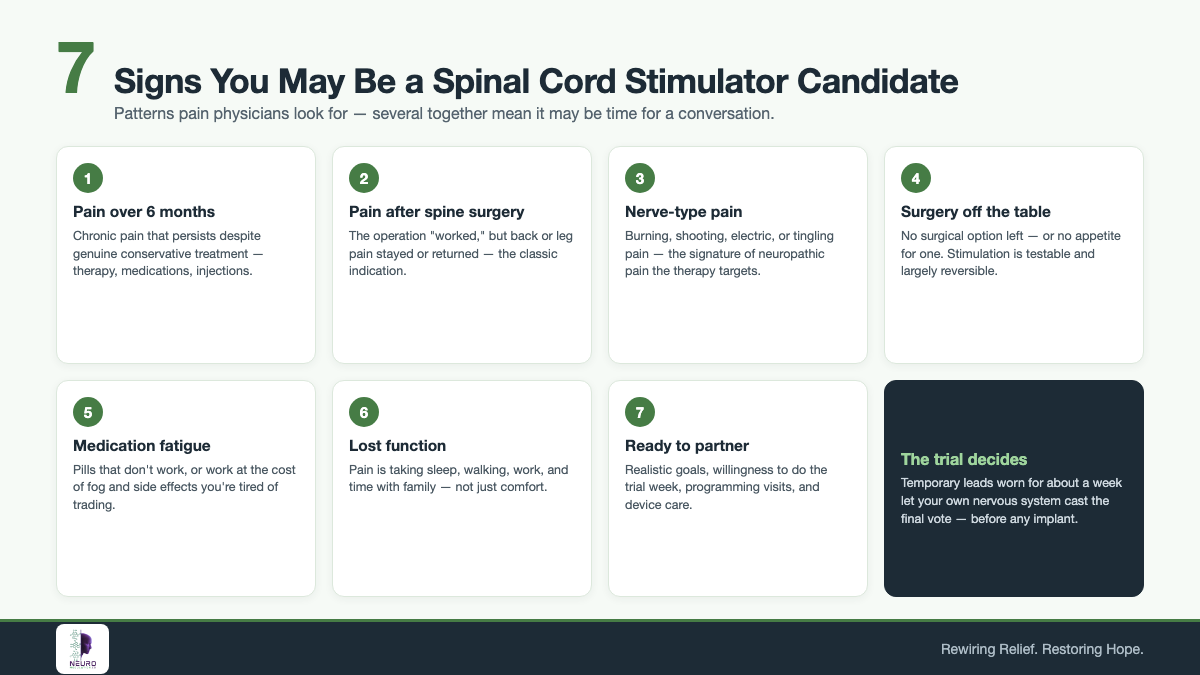
Crucially, candidacy isn’t decided on paper alone. The therapy includes a built-in trial period — temporary leads worn for about a week — so the final vote is cast by your own nervous system, in your own life. With that context, here are the seven signs.
7 Signs It May Be Time to Consider a Spinal Cord Stimulator
1. Your pain has lasted longer than six months despite real treatment
Chronic pain is generally defined as pain persisting beyond three to six months, but the key word in this sign is “despite.” A spinal cord stimulator candidate has typically worked through the earlier chapters: physical therapy given a genuine effort, appropriate medications, activity modification, often injections. If you’ve put in that time and the pain still dictates your days, you’ve satisfied the first — and most fundamental — criterion that physicians and insurers alike look for. If you haven’t explored the earlier options yet, start with our overview of pain management alternatives; stimulation will still be here if you need it.
2. You’ve had back or neck surgery, but the pain came back — or never left
This is the classic story. The MRI looked better after surgery. The surgeon says the operation was a success. And yet the burning in your leg or the ache in your back is still there — or returned within months. Persistent pain after structurally successful spine surgery is historically the most common and best-established reason for spinal cord stimulation, a use supported by decades of clinical research catalogued by the National Institute of Neurological Disorders and Stroke. If this is your story, you are in the heart of the candidate profile, and more surgery is often the less promising path: revision operations for pain alone, without a clear new structural problem, have a discouraging track record.
3. Your pain is burning, shooting, tingling, or electric
Words matter in pain medicine. When patients describe burning feet, electric jolts down a leg, pins and needles, or skin so sensitive a bedsheet hurts, they’re describing neuropathic pain — pain generated by damaged or malfunctioning nerves themselves. This is precisely the kind of pain spinal cord stimulation was built for, because the problem lives in the signaling system the stimulator speaks to. Painful diabetic neuropathy, nerve injury pain, and complex regional pain syndrome (CRPS) all fall in this family. A dull, mechanical ache that changes sharply with position, by contrast, often points elsewhere first.
4. Further surgery isn’t an option — or isn’t one you want
Some patients are told there’s nothing left to operate on. Others have surgical options but, after one or two rounds, understandably have no appetite for another. Both situations favor considering a stimulator, for a simple reason: spinal cord stimulation is testable and largely reversible. You trial it before committing. You can turn it off. It can be removed. It burns no bridges — every other option remains available afterward. When the alternative is irreversible surgery with uncertain benefit, that asymmetry matters a great deal.
Recognizing yourself in these signs?
A consultation can tell you in one visit whether a trial is worth pursuing.
5. Medications are losing the trade-off battle
Perhaps the medications never worked well. Perhaps they work, but at the cost of fog, fatigue, constipation, or worry about long-term dependence. Perhaps you’re simply tired of organizing your life around pills. One of the most consistent motivations I hear from patients seeking a spinal cord stimulator is the desire to need less medication — and because stimulation acts on the pain pathway directly rather than circulating through the whole body, it offers relief without systemic side effects. I’m careful with this point: successful stimulation doesn’t guarantee you’ll stop any particular medication, and any reduction should be planned with your prescriber. But many patients are able to meaningfully reduce their reliance, and wanting that is a legitimate reason to explore candidacy.
6. Your pain is stealing function, not just comfort
The candidates who do best aren’t only seeking lower numbers on a pain scale — they’re trying to get something back. Standing long enough to cook dinner. Walking the dog. Sitting through a grandchild’s recital. Sleeping past 3 a.m. When pain has taken measurable function from your life, two good things follow: you have concrete goals that make a trial easy to judge honestly, and you have the motivation that carries patients through programming and follow-up. If your pain is severe but your life is largely intact, the risk-benefit conversation looks different than when pain is costing you work, sleep, and relationships.
7. You’re ready to be a partner in the process — and the trial appeals to you
A spinal cord stimulator is not a procedure done to you; it’s a therapy you operate. Candidates need realistic expectations — meaningful relief and restored function, not a promise of zero pain — plus willingness to attend programming visits, manage charging if the system is rechargeable, and communicate honestly during the trial week. Relatedly, a standard psychological evaluation is part of every workup. Patients sometimes bristle at this, so let me say it plainly: it is not a test of whether your pain is “real.” It’s preparation — untreated depression, anxiety, or sleep disturbance measurably dampen outcomes, and addressing them first protects your result. If the idea of testing the therapy before committing strikes you as sensible rather than scary, that mindset itself is a good sign.
Signs You May Not Be a Spinal Cord Stimulator Candidate Right Now
Honesty cuts both ways, so here’s the other side of the ledger. A spinal cord stimulator is usually not the next step when:
- Your pain has a fixable mechanical cause — severe nerve compression that surgery can relieve, an unstable spine, a joint that needs replacement. Fix the structure first.
- Conservative care hasn’t genuinely been tried. Stimulation is an “after” therapy, not a first resort.
- You have an active infection anywhere, or a bleeding or anticoagulation issue that can’t be safely managed around a procedure — these typically delay, rather than permanently exclude, candidacy.
- Significant untreated psychological distress is in the picture. Again: a detour, not a dead end. Treat it, then revisit.
- Expectations can’t be aligned. If only complete, permanent elimination of pain would count as success, this therapy — like every pain therapy I know of — will disappoint.
Notice how many of these are “not yet” rather than “never.” Candidacy is a snapshot, not a verdict — and a borderline spinal cord stimulator candidate today is often a strong one six months from now.
What Happens Next: From Question to Answer
If several of the seven signs fit, here’s the realistic path from curiosity to clarity. First, a consultation: your history, imaging, prior treatments, and goals, reviewed with a physician who does this work routinely. Second, the workup: any needed updated imaging and the psychological evaluation. Third — and this is the step that makes spinal cord stimulation unusual in all of medicine — the trial: about a week living with temporary leads and an external stimulator, gathering your own evidence in your own life. Only then does anyone talk about an implant.
That structure means the cost of exploring your candidacy is low. The consultation costs you an hour. The trial costs you a week and a needle procedure. In exchange, you get something almost no other therapy offers: a personal, evidence-based preview of your result before you commit to anything. If neuromodulation as a field is still new to you, my plain-English primer — What Is Neuromodulation? — is a good companion to this article.

Frequently Asked Questions
How do doctors decide if I’m a spinal cord stimulator candidate?
Through a structured evaluation: confirming a diagnosis the therapy is known to help (persistent post-surgical pain, neuropathic pain, CRPS, painful diabetic neuropathy), verifying that conservative treatments have been adequately tried, screening for medical and psychological factors that need attention first, and then — decisively — a trial period. The trial is the real exam, and your own experience during it is the grade that matters most.
Can I be a candidate if I’ve never had back surgery?
Yes. While persistent pain after spine surgery is the classic indication, surgery is not a prerequisite. Patients with painful diabetic neuropathy, CRPS, and other neuropathic pain conditions are evaluated for stimulation without any surgical history. What matters is the character of the pain, the diagnosis, and the treatments already tried — not whether you’ve been under a scalpel.
Does age matter for spinal cord stimulator candidacy?
There’s no strict age cutoff. I’ve evaluated younger adults with CRPS and patients in their eighties with post-surgical leg pain. What matters more than the number is overall health: the ability to safely tolerate a minor outpatient procedure, manage the device, and participate in follow-up. Those questions get answered individually, in an exam room, not by a birthday.
What disqualifies someone from getting a spinal cord stimulator?
The firmest barriers are active untreated infection, inability to safely manage blood thinners around a procedure, untreated serious psychological conditions, and pain with a clearly fixable structural cause that should be addressed first. Most of these are temporary detours rather than permanent disqualifications — which is why a “no” from years ago is worth revisiting if your circumstances have changed.
The Honest Bottom Line
Seven signs, one theme: a strong spinal cord stimulator candidate is someone whose nerve-driven pain has outlasted reasonable treatment, who values function, and who appreciates a therapy humble enough to prove itself in a trial first. If that sounds like you, the next step isn’t a commitment — it’s a conversation.
This article is for educational purposes only and does not constitute medical advice. Candidacy for any medical device is an individualized determination made by a licensed physician after examining you. Please consult your own healthcare provider about your specific situation.
Find out where you stand.
Bring your history and your questions — leave with a clear picture of your options.
— Dr. Erika Petersen, MD, FAANS, FACS, is a board-certified neurosurgeon specializing in neuromodulation and a past president of the American Society of Pain & Neuroscience. Connect with her on LinkedIn.