
The spinal cord stimulator trial is, to my mind, one of the most patient-friendly ideas in all of surgery: before anyone implants anything permanent, you get to test the therapy in your own body, in your own life, for about a week. As a neurosurgeon who has guided many patients through this process — and as someone who has spent her career in neuromodulation — I want to walk you through exactly what happens, step by step, so that nothing on trial day comes as a surprise.
If you’re brand new to this field, it may help to start with my plain-English overview, What Is Neuromodulation?, or the companion piece on how spinal cord stimulation works. This article assumes you’ve heard the basics and now want the practical reality: what the trial actually feels like, hour by hour and day by day.
Why the Spinal Cord Stimulator Trial Exists at All
Chronic pain is stubbornly individual. Two patients with identical MRIs can have completely different pain, and the same therapy can help one and do little for the other. That’s why no honest physician will promise you a result — and why the spinal cord stimulator trial is built into the pathway as a requirement, not an option. Insurers require it, professional guidelines support it, and in my view good medicine demands it.
The trial answers the only question that really matters: does this therapy meaningfully help you? Not the average patient in a study. You, standing at your kitchen sink, walking your dog, trying to sleep through the night. Many well-selected patients get a clear answer within a week — and either answer is valuable. A successful trial gives you personal evidence before committing to an implant. An unsuccessful one spares you a surgery that wasn’t going to help, with almost nothing lost.
Step 1: The Evaluation Before the Trial
Before any needles are involved, there’s homework — mine and yours. I review your pain history, imaging, prior surgeries, and the treatments you’ve already tried. Spinal cord stimulation is generally considered after conservative care hasn’t delivered lasting relief, so we’ll talk honestly about what’s been attempted; our overview of pain management alternatives describes what usually comes first.
The conditions where the therapy is most established include persistent pain after spine surgery — often labeled failed back surgery syndrome — painful diabetic neuropathy, complex regional pain syndrome, and other forms of nerve-driven pain. You’ll also complete a standard psychological assessment. This isn’t a judgment; untreated depression, anxiety, or unrealistic expectations measurably worsen outcomes, and addressing them first protects your result. If you’re wondering whether you fit the profile, I’ve written a practical checklist: Am I a Candidate for a Spinal Cord Stimulator?
We’ll also plan the practical details: pausing certain blood thinners safely, screening for infection, and setting your personal goals for the week. I ask every patient to name two or three specific activities they want back. Those become the yardstick.
Wondering whether a trial makes sense for you?
The first step is a careful review of your history and goals.
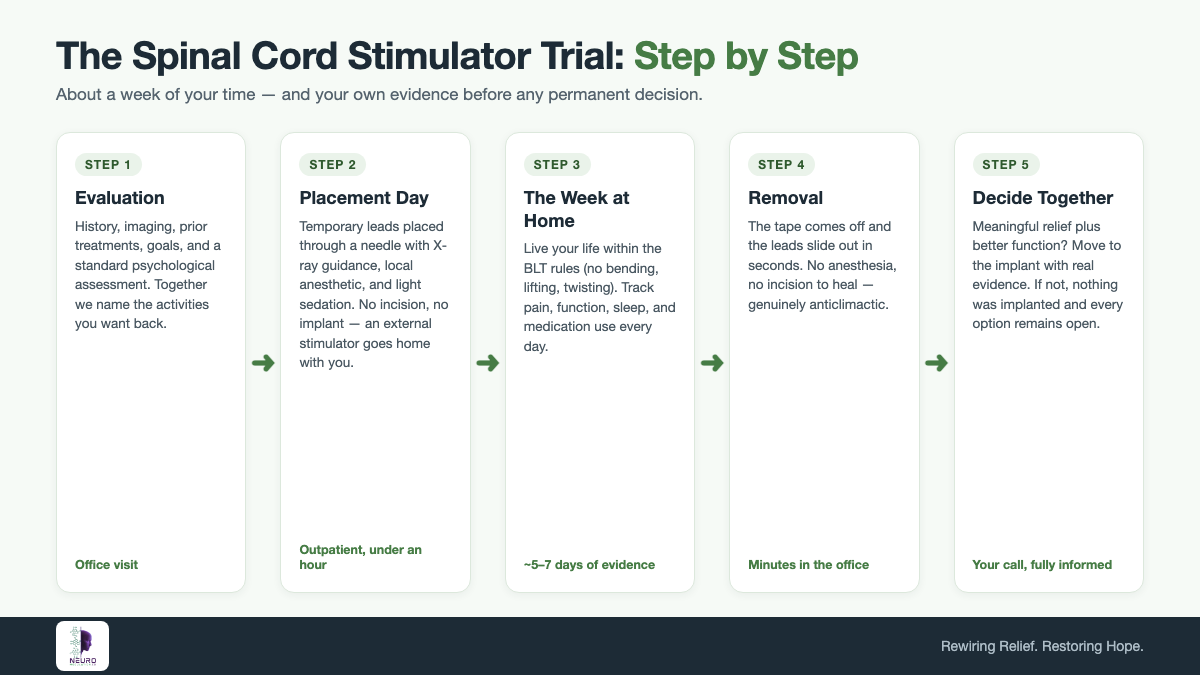
Step 2: Trial Day — What Actually Happens in the Procedure Room
The placement itself is an outpatient procedure, typically under an hour. Here’s the sequence:
- Arrival and preparation. You’ll check in, change into a gown, and have an IV placed for light sedation. You remain awake enough to answer questions — your feedback during placement matters.
- Positioning and numbing. You lie face down. The skin of your back is cleaned and numbed with local anesthetic. Most patients describe the rest as pressure rather than pain.
- Lead placement. Using X-ray guidance, I advance one or two thin, flexible leads through a needle into the epidural space — the same space used for epidural anesthesia. The leads rest near the spinal cord; nothing penetrates it, and there is no incision for the leads during a trial.
- Test stimulation. The leads are connected to a programmer, and we confirm the stimulation reaches your painful area. Depending on the system, you may feel a gentle tingling over your pain, or nothing at all with newer stimulation patterns.
- Securing and connecting. The leads are taped securely to your skin and connected to a small external stimulator worn on a belt or taped to your back. No generator is implanted during the trial — that’s the whole point.
You’ll go home the same day with a caregiver driving. Expect some soreness at the needle sites for a day or two, like a deep bruise.
Step 3: The Week at Home — Your Job as Chief Evidence Collector
The spinal cord stimulator trial usually runs several days to about a week. During that time, your job is to live as normally as the temporary setup allows and to collect evidence. I ask patients to track four things daily:
- Pain levels — morning, afternoon, and night, compared with your usual baseline.
- Function — the specific activities we named: standing longer at the sink, walking farther, climbing stairs, sitting through dinner.
- Sleep — nights of unbroken sleep are one of the most telling signals I see.
- Medication use — did you reach for pain medication less often?
There are a few temporary rules. Because the leads are held only by tape and your anatomy, you’ll avoid bending, lifting, twisting, and reaching overhead — patients memorably shorten these to the “BLT rules.” Showers are off the menu (sponge baths keep the dressing dry), and driving is restricted. A device representative typically checks in during the week to adjust programming — if the stimulation isn’t covering your pain well on day two, say so. Reprogramming mid-trial is normal and expected.
Step 4: Removal — Simpler Than Most Patients Expect
At the end of the week, you return to the office and the leads are removed. Patients often brace for this part, and it is genuinely anticlimactic: the tape comes off, the leads slide out in seconds, and a small bandage goes on. No anesthesia, no incision to heal, no recovery period. Whatever the outcome, the trial leaves your other options fully intact.
Step 5: Deciding Together — What Counts as a Successful Trial
The traditional benchmark for a successful spinal cord stimulator trial is meaningful relief — commonly discussed as substantial reduction in pain — plus improved function. I weight the second part heavily. A number on a pain scale matters less to me than whether you slept, walked, and reached for medication less. We sit down with your diary and decide together.
Three outcomes are possible. If the trial clearly helped, we schedule the permanent implant, usually a few weeks later, and you proceed with real personal evidence in hand. If it clearly didn’t, we don’t implant — and that is a success of the process, not a failure of you. If the result is ambiguous, we talk honestly: sometimes a different lead position, a different stimulation pattern, or a different therapy altogether is the right next move.
Have questions about the trial process?
Bring them to a consultation — every step should make sense before you begin.
Risks and Honest Caveats
A trial is low-risk, not no-risk. The needle sites can be sore. Leads can shift, changing where you feel stimulation. Infection is uncommon in a week-long trial but possible, which is why we screen beforehand and watch the sites. Rare but serious complications — bleeding around the spinal cord, nerve irritation — are exactly why this is done by trained physicians with imaging guidance, and why we review your medications so carefully beforehand.
One more honest caveat: a good trial week makes a good long-term result much more likely, but it is not an ironclad guarantee. Bodies change, leads can migrate, and programming needs ongoing attention after an implant. The trial is the best predictive tool we have — the National Institute of Neurological Disorders and Stroke offers useful background on chronic pain and its treatments at ninds.nih.gov — but I’d rather you hear its limits from me than discover them later.
How to Get the Most Out of Your Trial Week
- Test the activities that matter to you. Within the temporary movement rules, do the things your pain normally spoils. A trial spent on the couch answers nothing.
- Keep the diary religiously. Memory flattens a week into a single impression; a written record preserves the pattern.
- Call early about problems. Loose tape, fading coverage, odd sensations — mid-week fixes are routine.
- Involve your household. Spouses and family often notice changes — pacing, mood, sleep — before patients do.
- Judge the week as a whole. One bad afternoon doesn’t sink a trial, and one good morning doesn’t carry it.
Frequently Asked Questions
How painful is a spinal cord stimulator trial?
The placement is done with local anesthetic and light sedation; most patients report pressure rather than pain, followed by a day or two of bruise-like soreness at the needle sites. The stimulation itself should never hurt — if it does, it needs reprogramming, and you can turn it off yourself at any time.
How long does a spinal cord stimulator trial last?
Most trials run several days to about a week. That window is long enough to test the therapy across real life — good days, bad days, work, sleep — while keeping the temporary leads’ infection risk low.
Can I work during the trial week?
It depends on your job. Desk work is often manageable within the no-bending, no-lifting, no-twisting rules; physically demanding work generally is not. Many patients schedule the trial over a lighter week. We’ll plan this together beforehand.
What happens if the trial doesn’t work?
The leads come out in minutes, nothing has been implanted, and every other treatment option remains open. An unsuccessful spinal cord stimulator trial is disappointing, but it has done its job: it stopped you from undergoing a permanent procedure that wasn’t going to help.
The Bottom Line
The spinal cord stimulator trial is the rare opportunity in medicine to test-drive a surgical therapy before committing to it. It asks a week of your time and some temporary inconvenience, and in exchange it replaces hope and guesswork with your own evidence. If chronic pain has outlasted surgery, medications, and patience, understanding the trial is the logical next step — and walking through it with a physician who will respect either answer is the right way to take it.
— Dr. Erika Petersen, MD, FAANS, FACS, is a board-certified neurosurgeon specializing in neuromodulation and a past president of the American Society of Pain & Neuroscience. Connect with her on LinkedIn.
This article is educational only and is not medical advice. Individual results vary, and nothing here replaces an in-person evaluation with a licensed physician. Please consult your own healthcare provider about your specific situation.
Ready to find out if a trial is your next step?
Schedule a consultation and get answers specific to your situation.