
Complex regional pain syndrome is one of the most misunderstood conditions I treat. Patients often spend months being told their pain is out of proportion to their injury — which, in a sense, is exactly the definition of CRPS — before anyone gives it a name. By the time they reach a neuromodulation specialist, many feel they’ve been sent to the end of the line. I want to change that framing. CRPS treatment neuromodulation options belong much closer to the front of the conversation than many patients realize, and as a neurosurgeon who has spent her career in this field, I’ll explain why — and where the honest limits of that claim are.
For a clinical overview of the condition itself, see our page on complex regional pain syndrome (CRPS). This article focuses on treatment, and specifically on the role of stimulation.
What CRPS Is — and Why It Behaves So Differently
CRPS is a chronic pain condition that usually affects an arm, hand, leg, or foot, most often after an injury such as a fracture, sprain, or surgery. Instead of healing along the expected timeline, the nervous system amplifies and sustains the pain long after tissues have recovered. It’s classically described in two forms: Type I, without a confirmed nerve injury, and Type II, with one. Both can be equally disabling.
Its hallmarks include:
- Burning, intense pain that is far greater than the original injury would explain.
- Extreme sensitivity, where a light touch, a bedsheet, or a breeze can be painful (allodynia).
- Changes in skin color and temperature, often alternating between warm and red and cool and bluish.
- Swelling and sweating differences in the affected limb.
- Changes in hair and nail growth and, over time, stiffness and loss of motion.
CRPS is diagnosed clinically using established criteria, after other explanations have been ruled out. Because it’s driven by changes in the nervous system rather than ongoing tissue damage, it’s a classic example of neuropathic pain — and that is exactly why neuromodulation makes sense. The National Institute of Neurological Disorders and Stroke maintains an authoritative patient overview at ninds.nih.gov.
The Foundations of CRPS Care
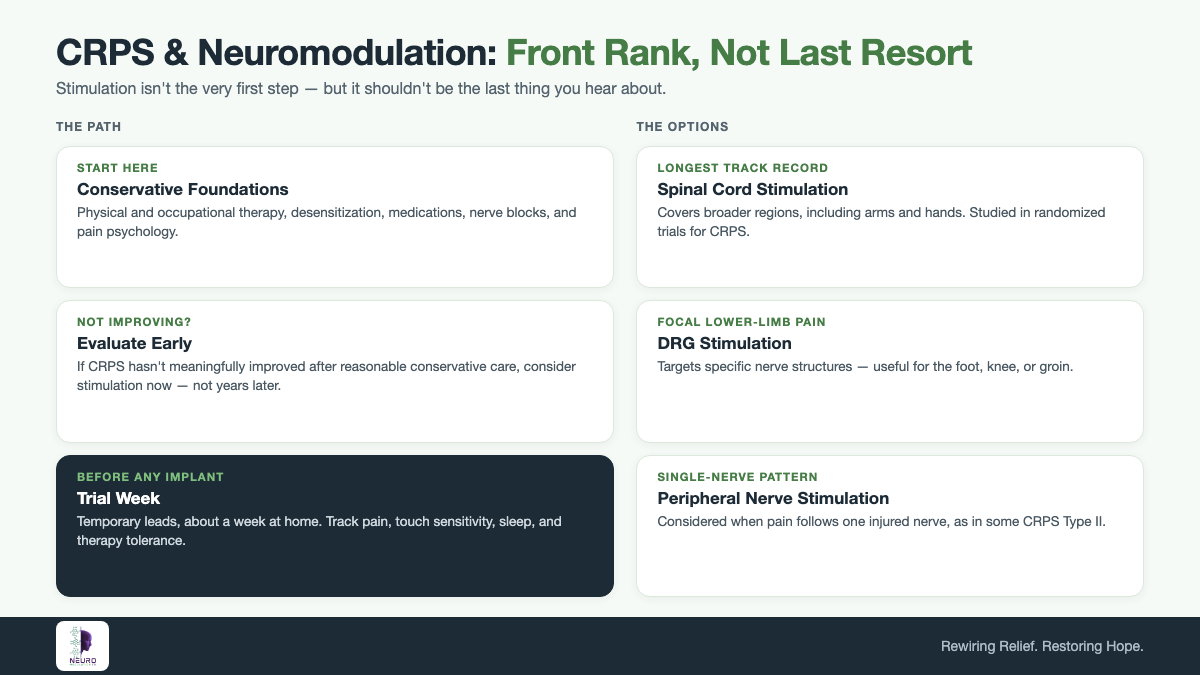
Good CRPS care begins with a multidisciplinary approach, and every patient I see should understand that stimulation is designed to work with these foundations, not replace them:
- Physical and occupational therapy. Gentle, graded movement and desensitization are central. Keeping the limb moving helps prevent stiffness and disuse, and techniques like graded motor imagery and mirror therapy may help retrain the brain’s map of the limb.
- Medications. Depending on the stage and symptoms, physicians may use anti-inflammatories, nerve-pain medications, and other agents. Responses vary widely.
- Sympathetic nerve blocks. Injections that temporarily block sympathetic nerves can reduce pain for some patients and create a window for more effective therapy.
- Psychological support. Living with CRPS is exhausting. Pain psychology and coping strategies are evidence-based parts of treatment, not an implication that pain is imagined.
For some patients, especially when CRPS is caught early, these approaches are enough. For many others, pain persists and function keeps shrinking despite real effort. That is where the question of timing becomes critical.
Why CRPS Treatment Neuromodulation Options Are So Well Established
CRPS is one of the conditions for which spinal cord stimulation has the strongest track record. It has been studied in randomized trials and over decades of clinical use, and it appears in professional guidelines and insurance coverage criteria as an appropriate therapy for patients whose CRPS hasn’t responded adequately to conservative care. Dorsal root ganglion (DRG) stimulation, a more targeted form of spinal stimulation, has also been studied specifically in CRPS and causalgia affecting the lower limbs.
Why does stimulation fit CRPS so well? Because the problem lives in the nervous system. Spinal cord stimulation delivers mild electrical signals near the spinal cord, changing how pain signals from the affected limb are processed before they reach the brain. Many well-selected patients report meaningful reductions in pain and allodynia, and some notice improvements in the limb’s temperature and color as well. Just as important, reduced pain can make physical therapy possible again — and movement is one of the keys to recovery in CRPS. I explain the mechanism in detail in Spinal Cord Stimulation: How It Works and Who It Helps.
Living with CRPS that isn’t improving?
Let’s talk about whether stimulation belongs in your plan now.
Is Stimulation Really “First-Line”? An Honest Answer
I chose the phrase “first-line” deliberately, so I want to be precise about what I mean. Stimulation is not usually the very first treatment for a new CRPS diagnosis. Therapy, medications, and other conservative measures come first, and they should be given a genuine chance.
But “first-line” also has a broader meaning: being in the front rank of options, rather than a last resort. By that standard, CRPS treatment neuromodulation therapies have earned their place. They are an established, evidence-supported option, and many specialists now encourage considering them relatively early — once it’s clear that CRPS isn’t responding to initial care — rather than waiting until every other option has been exhausted over many years. The reasoning is simple: CRPS can become harder to reverse as it persists, and disuse, stiffness, and central sensitization tend to compound over time.
So my honest summary is this: stimulation isn’t the first thing you try, but it shouldn’t be the last thing you hear about. If your CRPS hasn’t meaningfully improved after a reasonable period of good conservative care, a CRPS treatment neuromodulation evaluation belongs on the table now.
Spinal Cord Stimulation vs. DRG Stimulation for CRPS
Patients with CRPS are often good candidates for more than one type of stimulation, and the right choice depends largely on where the pain is:
- Traditional spinal cord stimulation covers broader regions and has the longest track record in CRPS, including CRPS of the arm or hand.
- DRG stimulation targets specific nerve structures and can be especially useful for focal pain in places that are traditionally hard to cover, such as the foot, knee, or groin.
- Peripheral nerve stimulation may be considered when pain clearly follows the territory of a single injured nerve, as in some cases of CRPS Type II.
I go through the trade-offs in depth in DRG Stimulation vs. Traditional Spinal Cord Stimulation: Key Differences. The decision is individualized, and in some cases a trial helps clarify which approach fits best.
The Trial: Testing Before Committing
Every CRPS treatment neuromodulation pathway that leads to an implant begins with a trial. Temporary leads are placed through a needle and connected to an external stimulator for about a week. During that time you track pain, sensitivity, sleep, function, and medication use — and for CRPS patients I also ask them to note how well they tolerate touch, clothing, and therapy exercises. If the trial clearly helps, a permanent system is discussed. If not, the leads come out in minutes and nothing has been implanted. I describe each stage in The Spinal Cord Stimulator Trial: What Actually Happens, Step by Step.
For CRPS patients specifically, there are a few extra considerations: we take care to minimize any trauma to the affected limb, we coordinate closely with your therapists, and we watch carefully for any flare in symptoms around the procedure.
Curious whether a trial makes sense for your CRPS?
A careful evaluation will tell us whether you’re ready for the next step.
Realistic Expectations and Risks
CRPS is a difficult condition, and I won’t pretend otherwise. Stimulation rarely eliminates pain completely; the realistic goal is meaningful relief that lets you sleep, move, and participate in your life and therapy again. Results vary from person to person. Risks include infection, lead movement requiring reprogramming or revision, discomfort at the generator site, and, rarely, more serious complications. Long-term, devices require programming visits and eventual battery replacement. A thoughtful CRPS treatment neuromodulation plan builds all of this in from the start, alongside continued therapy and support.
Building the Right Team Around You
CRPS outcomes tend to be best when care is coordinated rather than fragmented. Before and after any procedure, I like to know who else is on a patient’s team: the physical or occupational therapist working on desensitization and movement, the physician managing medications, and, ideally, a pain psychologist who can help with the stress, sleep disruption, and fear of movement that so often accompany this condition. A CRPS treatment neuromodulation evaluation is a good moment to fill any gaps in that team.
It’s also worth bringing a few things to your first visit: a timeline of when your symptoms started and how they’ve changed, a list of every treatment you’ve tried and how it worked, photos of color or swelling changes if they come and go, and a short list of the activities you most want back. That information helps us judge whether you’re ready for a trial now, whether something else should come first, and which type of stimulation fits your pattern of pain. Thoughtful preparation makes CRPS treatment neuromodulation decisions faster, clearer, and more personal.
Frequently Asked Questions
Is spinal cord stimulation effective for CRPS?
CRPS is one of the conditions where spinal cord stimulation is best established, supported by randomized trials and long clinical experience. Many well-selected patients report meaningful pain relief, though results vary and no therapy works for everyone.
How long should I try other treatments before considering stimulation?
There’s no single rule, but if your CRPS hasn’t meaningfully improved after a reasonable period of good conservative care, it’s worth having an evaluation rather than waiting years. Your specialist will help judge the right timing.
Can a procedure on my spine make my CRPS worse?
Stimulator leads are placed at the spine, away from the affected limb, which helps limit trauma to the painful area. Any procedure carries some risk of a flare, and your team will plan carefully to minimize it.
Will I still need physical therapy after an implant?
Yes, and that’s often the point. Many patients find that stimulation makes therapy more tolerable and more productive. Movement remains one of the most important parts of CRPS recovery.
The Bottom Line
CRPS asks a lot of the people who live with it, and they deserve to hear about every effective option early. Stimulation isn’t the very first step, but it is one of the best-established tools we have, and CRPS treatment neuromodulation approaches belong in the front rank of the conversation — not saved for last. If your CRPS isn’t improving, an evaluation with a neuromodulation specialist is a reasonable next step.
— Dr. Erika Petersen, MD, FAANS, FACS, is a board-certified neurosurgeon specializing in neuromodulation and a past president of the American Society of Pain & Neuroscience. Connect with her on LinkedIn.
This article is educational only and is not medical advice. Individual results vary, and nothing here replaces an in-person evaluation with a licensed physician. Please consult your own healthcare provider about your specific situation.
Ready to explore your CRPS treatment options?
Schedule a consultation and get answers specific to your situation.