
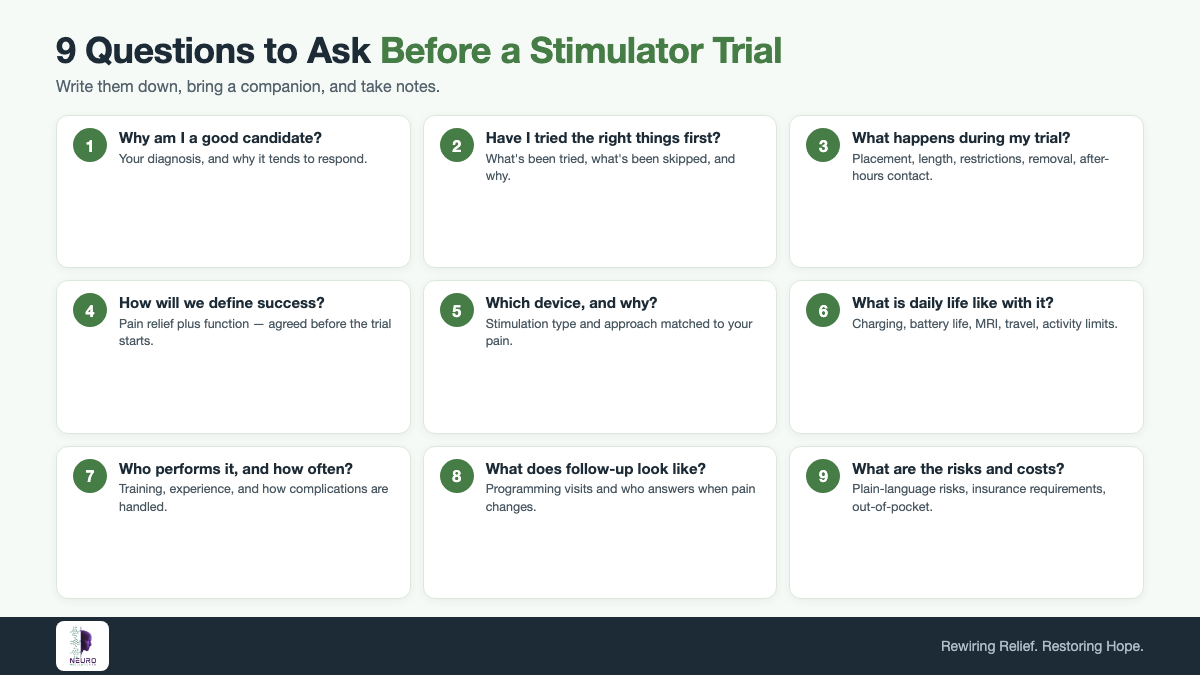
The best patients I’ve ever treated arrived with a list. Not because they doubted me, but because they understood that a stimulator trial is a real decision and deserved real answers. If you’re considering one, I’d like you to walk in with the same kind of list. Below are the nine spinal cord stimulator questions I believe every patient should ask before a trial — and, as a neurosurgeon who has spent her career in neuromodulation, what a good answer should sound like.
If you’re still at the beginning of your research, you may want to read Spinal Cord Stimulation: How It Works and Who It Helps first. This guide assumes you’re past “what is it?” and approaching “should I try it?”
Why Your Spinal Cord Stimulator Questions Matter
A stimulator trial is low-risk and reversible, but it’s still a procedure, and it sits at the start of a pathway that may end in a permanent implant. Patients who understand that pathway tend to have more realistic expectations, follow the recovery rules more carefully, and communicate more clearly with their programming team — all of which help outcomes. Asking good spinal cord stimulator questions isn’t being difficult. It’s being a partner in your own care.
A practical tip before we begin: write your questions down, bring someone with you if you can, and take notes. It’s easy to forget details when you’re processing a lot of new information, and a second set of ears often catches an answer you missed or a follow-up question you didn’t think to ask.
Questions About Whether a Stimulator Is Right for You
1. “Why do you think I’m a good candidate?”
Ask your physician to explain, specifically, what about your pain and history makes stimulation a reasonable option. A good answer will name your diagnosis — for example, persistent pain after spine surgery, complex regional pain syndrome, or nerve-related leg pain — and explain why that condition tends to respond. It should also acknowledge anything that might make your result less predictable. If you’d like to check the criteria yourself, I’ve written a detailed checklist: Am I a Candidate for a Spinal Cord Stimulator?
2. “Have I tried the right things first?”
Stimulation is generally considered after reasonable conservative care hasn’t delivered lasting relief. That doesn’t mean you must try everything ever invented, but you should understand which options have been tried, which were skipped, and why. A good answer will review your history honestly and, if something important hasn’t been tried, say so. Our overview of pain management alternatives describes the usual earlier steps.
Bring your list to a consultation.
Every one of your questions deserves a clear, honest answer.
Questions About the Trial Itself
3. “What exactly will happen during my trial, and how long will it last?”
You should leave knowing how the temporary leads will be placed, what kind of anesthesia or sedation is used, how long the trial lasts (often around a week), what activity restrictions apply, and how the leads come out. You should also know who to call if something goes wrong at night or on a weekend. I’ve written a full walkthrough of the process in The Spinal Cord Stimulator Trial: What Actually Happens, Step by Step, which you can use to check the answers you’re given.
4. “How will we decide whether the trial worked?”
This is one of the most important spinal cord stimulator questions, and it’s surprisingly often skipped. A traditional benchmark is meaningful pain relief, but I also put heavy weight on function: walking, sleeping, standing, working, and medication use. Agree on your personal goals before the trial so you’re judging the week against something concrete. Ask what happens if the result is ambiguous — a good team will have a plan for reprogramming, reconsidering lead placement, or exploring other therapies.
Questions About the Device and Technology
5. “Which device and stimulation approach are you recommending, and why?”
There are several manufacturers and many stimulation patterns. Some produce a tingling sensation over the painful area; others are designed to produce little or no sensation. Some patients are better served by a more targeted option such as dorsal root ganglion stimulation, which I compare in DRG Stimulation vs. Traditional Spinal Cord Stimulation. A good answer explains the reasoning behind the recommendation for your pain, not just which device the practice usually uses.
6. “What will living with this device be like?”
Ask about the practical details. Is the generator rechargeable, and how often will you need to charge it? How long is the battery expected to last before replacement? Is the system compatible with MRI scans, and under what conditions? How will it affect airport security, and are there activities you’ll need to avoid? These answers shape your daily life for years, so it’s worth getting them now. It’s also reasonable to ask what the first few months after a permanent implant typically involve — how long activity restrictions last, when you might return to work, and when the first programming visit happens — so you can plan around your job and family before you ever begin.
Questions About Experience and Follow-Up
7. “Who will perform my procedure, and how often do you do this?”
It’s entirely appropriate to ask about your physician’s training and experience with stimulator trials and implants, who else is involved, and how complications are handled. Neuromodulation is performed by physicians from several specialties, including neurosurgeons and pain medicine specialists. What matters most is focused training, regular experience, and a team that will be there for the long haul. A confident physician will welcome this question, and should also be comfortable telling you when a different specialist or a different therapy might serve you better.
8. “What does follow-up and programming look like?”
Your relationship with a stimulator doesn’t end in the procedure room. Ask how often you’ll have programming visits, who does the programming, how quickly adjustments can be made if your pain changes, and how to reach the team between appointments. Good long-term results depend heavily on responsive follow-up, so a clear answer here is a very good sign.
It’s also worth asking how the practice works with the device manufacturer’s representatives, who often help with programming, and what happens if you move or change insurance. Stimulators are long-term relationships. You want to know that someone will answer the phone five years from now, when your pain changes or your battery needs attention, just as readily as they did before your trial.
Questions About Risks and Cost
9. “What are the risks, and what will this cost me?”
Every procedure has risks, and you deserve to hear them plainly. For a trial, these typically include soreness, lead movement, and a small risk of infection; for a permanent implant, additional risks include problems at the generator site, the possible need for revision surgery, and, rarely, more serious complications such as bleeding or nerve injury. The National Institute of Neurological Disorders and Stroke offers helpful background on chronic pain and its treatment at ninds.nih.gov.
On cost, ask what your insurance requires (many plans require documented conservative care, a psychological evaluation, and a successful trial), what your out-of-pocket responsibility is likely to be for the trial and the implant, and who in the office can help you navigate prior authorization.
Red Flags to Listen For in the Answers
Most physicians who offer stimulation will answer your spinal cord stimulator questions thoughtfully. Still, a few kinds of answers should make you pause and, perhaps, seek a second opinion:
- Guarantees. No honest physician can promise a specific result. Phrases like “this will fix your pain” or “everyone does great” overstate what any therapy can do.
- Skipping the trial. A trial is a standard part of the pathway for good reason. Be cautious of any suggestion to go straight to a permanent implant without one.
- Vague success criteria. If no one can tell you how the trial will be judged, it will be hard to make a confident decision afterward.
- No clear follow-up plan. Programming and long-term support are essential. If it’s unclear who will manage your device after the implant, ask until it isn’t.
- Dismissing your questions. Feeling rushed or brushed off is worth noticing. A procedure you’ll live with for years deserves unhurried conversation.
Questions Your Doctor Will Likely Ask You
The conversation goes both ways. To prepare, think about how you’d answer the questions I ask nearly every patient: Where exactly is your pain, and does it radiate? What does it feel like — burning, aching, electric? What makes it better or worse? Which treatments have you tried, for how long, and what happened? Which medications do you take now? And, most importantly, which two or three activities would you most like to get back? Clear answers to these help your physician tailor both the trial and the device to you, and they make your own spinal cord stimulator questions sharper, too.
Frequently Asked Questions
What are the most important spinal cord stimulator questions to ask?
If you only have time for a few, ask why you’re a good candidate, how trial success will be defined, what follow-up and programming look like, and what the risks and costs are. Those four cover the decisions that matter most.
Is it okay to get a second opinion before a stimulator trial?
Absolutely. A second opinion is reasonable for any significant procedure, and a good physician will support it. Bring your imaging and records so the second physician has the full picture.
Should I talk to other patients who have a stimulator?
Other patients’ experiences can be helpful context, but remember that every case is different. Your own trial week is the best evidence of how stimulation works for you.
What if I think of questions after my appointment?
Call or message the office. There is no limit on spinal cord stimulator questions, and it’s far better to ask before the trial than to wonder during it.
The Bottom Line
A stimulator trial is one of the most patient-friendly steps in all of surgery: a chance to test a therapy before committing to it. Make the most of it by arriving prepared. These nine spinal cord stimulator questions will help you understand your options, set clear goals, and choose a team you trust — which is exactly where a good outcome begins.
— Dr. Erika Petersen, MD, FAANS, FACS, is a board-certified neurosurgeon specializing in neuromodulation and a past president of the American Society of Pain & Neuroscience. Connect with her on LinkedIn.
This article is educational only and is not medical advice. Individual results vary, and nothing here replaces an in-person evaluation with a licensed physician. Please consult your own healthcare provider about your specific situation.
Considering a stimulator trial?
Schedule a consultation and get answers specific to your situation.