
When patients hear that a spinal cord stimulator can be “programmed,” they often picture a single dial that turns the power up or down. The reality is more interesting. Modern systems can deliver several distinct patterns of electrical energy, and the choice between them shapes what stimulation feels like and how well it fits your pain. In this guide I’ll explain the three programming modes my patients ask about most — traditional tonic stimulation, burst stimulation, and high frequency spinal cord stimulation — in plain language, as a neurosurgeon who has spent her career in neuromodulation.
If you’re new to the therapy itself, start with Spinal Cord Stimulation: How It Works and Who It Helps. This article assumes you know the basic idea — thin leads near the spinal cord, a small generator, and gentle electrical signals that change how pain messages reach the brain — and focuses on the settings that bring that hardware to life.
Why Programming Modes Matter at All
A stimulator is only as helpful as the signal it sends. Two patients can have identical hardware placed in identical positions and still need very different programs, because pain is personal. One person’s leg pain may respond beautifully to a gentle tingling sensation; another person may find that same tingling distracting, uncomfortable, or simply ineffective.
Programming describes several adjustable features of the signal:
- Frequency — how many electrical pulses are delivered each second.
- Pulse width — how long each individual pulse lasts.
- Amplitude — how strong each pulse is.
- Pattern — whether the pulses arrive in a steady stream, in grouped packets, or in some combination.
- Contacts — which of the small electrodes along the lead are active, which shapes where the energy goes.
Different combinations of these features are what we call programming modes, or waveforms. Device manufacturers have developed their own versions and names, but the underlying categories are shared across the field. I’ll describe them generically here, because the principles matter more than the branding.
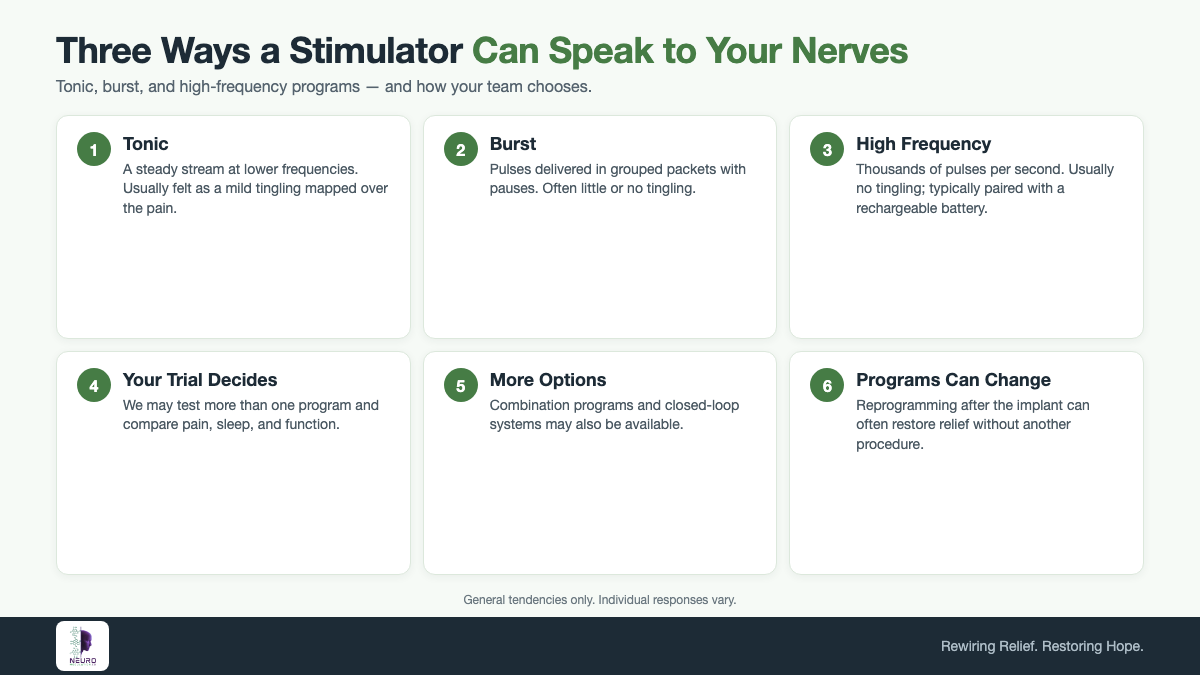
Tonic Stimulation: The Traditional Approach
Tonic stimulation is the original form of spinal cord stimulation and remains widely used. It delivers a steady, regular stream of pulses at relatively low frequencies. Most patients feel it as a mild tingling or buzzing sensation, called paresthesia, that covers the painful area.
The traditional goal of tonic programming is to “map” that tingling over the region where you hurt. When the overlap is good, many patients find the pleasant buzz replaces or masks much of the pain signal. During programming, you’ll often be asked where you feel the sensation so the team can steer it precisely.
Who tends to like tonic stimulation
Some patients genuinely prefer feeling their device. The sensation reassures them it’s working, and they like being able to adjust it on the fly with their remote. Tonic programs also tend to be energy-efficient, which can matter for battery choices. On the other hand, some people find the tingling changes with position — stronger when lying down, weaker when standing — and that variability can be bothersome.
Burst Stimulation: Packets Instead of a Steady Stream
Burst stimulation delivers pulses in small, closely spaced groups, followed by a brief pause, then another group. Rather than one constant stream, the signal arrives in packets. The idea behind this pattern is that it may interact with pain-processing pathways somewhat differently than tonic stimulation does, including pathways involved in how pain feels emotionally, not just physically.
Many patients experience burst stimulation with little or no tingling. For people who disliked paresthesia during a trial, or who notice their pain more at night when a buzzing sensation can be distracting, that difference can matter a great deal. Researchers continue to study exactly how burst patterns work, and individual responses vary.
Curious which programming mode fits your pain?
A consultation is the best way to talk through your options.
High Frequency Spinal Cord Stimulation Explained
High frequency spinal cord stimulation delivers pulses far faster than traditional tonic programs — in the kilohertz range, meaning thousands of pulses per second. At these rates, the signal is generally below the threshold you can feel, so most patients notice no tingling at all. This is often described as “paresthesia-free” or “sub-perception” therapy.
Because there’s no tingling to map, programming for high frequency spinal cord stimulation works differently. Rather than asking where you feel a buzz, your team typically positions the leads based on anatomy and then adjusts settings over days to weeks based on how your pain responds. Patients sometimes find this unusual at first; it can take time to judge a therapy you can’t feel.
Practical considerations
Delivering thousands of pulses every second uses more energy than a low-frequency program. For that reason, high frequency spinal cord stimulation is usually paired with a rechargeable generator. Paresthesia-free programs also tend to feel consistent across positions, which some patients appreciate when they move between sitting, standing, and lying down throughout the day. Some people also find it easier to drive or sleep without a noticeable sensation, though you should always follow your own device’s instructions about driving.
It’s worth saying plainly: “higher” is not automatically “better.” High frequency spinal cord stimulation is one well-established option among several, and the best mode for you depends on your diagnosis, the location of your pain, your preferences, and how you respond during a trial.
Other Patterns You May Hear About
The field keeps evolving, and you may hear about additional approaches during a consultation:
- Combination or multi-waveform programs deliver more than one pattern at once, or let you switch between programs depending on the time of day or activity.
- Closed-loop systems measure the spinal cord’s response to each pulse and automatically adjust output, aiming to keep stimulation steady as you move.
- Other sub-perception patterns use moderate frequencies or specialized pulse shapes to provide paresthesia-free relief with different energy demands.
Many current systems can deliver several of these modes from the same hardware. That flexibility is valuable, because the program that works best in your first year may not be the one that works best in your fifth. Also keep in mind that programming modes are separate from targets: a more focused option such as dorsal root ganglion stimulation, which I compare in DRG Stimulation vs. Traditional Spinal Cord Stimulation, changes where stimulation is delivered rather than just how.
Comparing the three main modes side by side
| Feature | Tonic | Burst | High Frequency |
|---|---|---|---|
| Signal pattern | Steady stream, lower frequency | Grouped packets with pauses | Very rapid stream, kilohertz range |
| What you feel | Usually a mild tingling | Often little or no tingling | Usually no tingling |
| How it’s programmed | Map the tingling over the pain | Adjusted by response and comfort | Anatomic placement, adjusted by response |
| Energy use | Generally lower | Moderate | Generally higher; usually rechargeable |
| Position sensitivity | Can vary with posture | Often more consistent | Often more consistent |
These are general tendencies, not rules. Individual experiences vary, and your programming team will tailor settings to you.
How We Choose a Mode During Your Trial
The trial is where these choices become personal. During a trial, temporary leads let you test stimulation in your real life for about a week before any permanent decision. I’ve described the full process in The Spinal Cord Stimulator Trial: What Actually Happens, Step by Step.
In my practice, choosing a mode usually involves a few conversations:
- Your pain pattern. Where it is, whether it’s in one area or many, and whether it has a burning, electric, or aching quality.
- Your feelings about sensation. Some patients want to feel their device; others strongly prefer not to. Both are valid.
- Your lifestyle. Sleep, work, driving, and how comfortable you are with recharging a device.
- Your response. We may try more than one program during the trial and compare how each affects pain, sleep, and daily function.
Because many systems support multiple modes, the decision isn’t always either-or. Patients sometimes keep two or three programs available and choose between them as their days demand.
It also helps to arrive with questions written down. Ask which modes your recommended system supports, whether high frequency spinal cord stimulation is an option for your type of pain, and how the team will judge which program is working. I’ve gathered the questions I think matter most in 9 Questions to Ask Your Doctor Before a Stimulator Trial.
Programming Doesn’t End After Surgery
One of the most reassuring facts about modern stimulators is that the program can change long after the implant. Pain shifts over time. Activity levels change. A program that worked beautifully for months may become less effective, and a reprogramming visit — or a switch to a different mode, such as moving to or away from high frequency spinal cord stimulation — can often restore relief without another procedure.
The early weeks after a permanent implant are a common time for fine-tuning, as swelling settles and the leads heal into place. I describe that period in more detail in my guide to spinal cord stimulator recovery.
That’s why I encourage patients to report changes promptly instead of quietly living with less relief. Follow-up programming is part of the therapy, not an afterthought. For broader background on long-term pain care, the National Institute of Neurological Disorders and Stroke offers helpful patient information.
Not sure your current program is working as well as it could?
Let’s talk about your goals and your options.
Frequently Asked Questions
Is high frequency spinal cord stimulation better than tonic stimulation?
Not universally. Each mode has patients who do very well with it. Research has compared different waveforms, and results vary by condition and by individual. The right choice depends on your pain and your trial response, which is why testing during a trial is so valuable.
Will I feel tingling with my stimulator?
It depends on the mode. Tonic programs usually produce a mild tingling, while burst and high-frequency programs are often designed to be felt little or not at all. If you have a strong preference, share it before your trial.
Can my programming mode be changed later?
Often, yes. Many systems support several waveforms, and your team can adjust or switch programs at follow-up visits. Some changes may depend on your specific hardware, so ask about upgrade flexibility before your implant.
Does the programming mode affect battery life?
Yes. Modes that deliver more pulses per second generally use more energy, which affects how often a rechargeable device needs charging and how long a non-rechargeable battery lasts. Your team will factor this into your device recommendation.
The Bottom Line
Tonic, burst, and high-frequency stimulation are different ways of speaking to the same nervous system. None is a magic setting, and none is wrong. The best program is the one that gives you meaningful relief, fits the way you live, and can evolve as your needs change. If you’re exploring stimulation — or you already have a device and wonder whether a different mode might help — a thoughtful conversation with an experienced neuromodulation team is the place to start.
— Dr. Erika Petersen, MD, FAANS, FACS, is a board-certified neurosurgeon specializing in neuromodulation and a past president of the American Society of Pain & Neuroscience. Connect with her on LinkedIn.
This article is educational only and is not medical advice. Individual results vary, and nothing here replaces an in-person evaluation with a licensed physician. Please consult your own healthcare provider about your specific situation.
Considering spinal cord stimulation?
Schedule a consultation and get answers specific to your situation.