
Spinal cord stimulation is the therapy I’ve built much of my career around, and as a board-certified neurosurgeon — I’m Dr. Erika Petersen — I still find it remarkable: a device roughly the size of a silver dollar, placed under the skin, that can change how a person experiences pain. Not by numbing the body. Not by sedating the mind. By speaking the nervous system’s own electrical language.
If you’re reading this, chances are someone — a surgeon, a pain specialist, a physical therapist — has mentioned spinal cord stimulation as an option, and you want to understand what you’d actually be signing up for. This article is my attempt to explain it the way I would across the desk from you: honestly, in plain English, and without overselling.
What Is Spinal Cord Stimulation?
Spinal cord stimulation (often shortened to SCS) is a form of neuromodulation — a treatment that delivers mild electrical pulses to the spinal cord to interrupt or quiet pain signals before they reach the brain. If neuromodulation as a whole is new to you, start with my plain-English overview, What Is Neuromodulation?, and then come back here.
The system has three essential parts:
- Leads — thin, flexible insulated wires with small electrical contacts, positioned in the epidural space, the same area where epidural anesthesia is given. The leads sit near the spinal cord; nothing penetrates it.
- A pulse generator — a small battery-powered device, implanted under the skin (usually in the upper buttock or flank), that creates the electrical pulses. Patients often call it “the battery.” Think of a pacemaker, but for pain rather than the heart.
- A controller — a remote or app that lets you adjust stimulation within physician-set limits: stronger, gentler, different programs for sitting versus walking versus sleeping.
Some generators are rechargeable through the skin with a wearable charger; others use long-life primary batteries that are replaced in a minor procedure when depleted. Neither is universally “better” — it’s a lifestyle conversation we have during planning.
How Spinal Cord Stimulation Works
Your spinal cord is the main cable between body and brain. Pain signals from an arm, a leg, or your back travel along nerves into the spinal cord and then up to the brain. Decades ago, researchers described a “gate” in the spinal cord where these signals can be amplified or dampened. Spinal cord stimulation works at that gate.
By delivering carefully shaped electrical pulses to the back of the spinal cord, the device changes how pain signals are transmitted. With traditional stimulation, patients feel a mild tingling (called paresthesia) that overlaps the painful area — the tingling effectively crowds out the pain. Newer stimulation patterns, developed over the past decade, work at frequencies or in bursts that many patients can’t feel at all; the goal there is to calm the overactive nerve circuits themselves rather than mask them.
Two honest points worth making. First, no one fully understands every mechanism at play — the nervous system is humbling that way, and research is ongoing. Second, spinal cord stimulation changes how pain is processed and perceived; it does not repair a damaged disc or regrow a nerve. That’s not a weakness — for nerve-driven chronic pain, the faulty signal processing often is the disease — but it’s important to understand what the therapy does and doesn’t do. Our site’s primer on what SCS therapy is covers additional background.
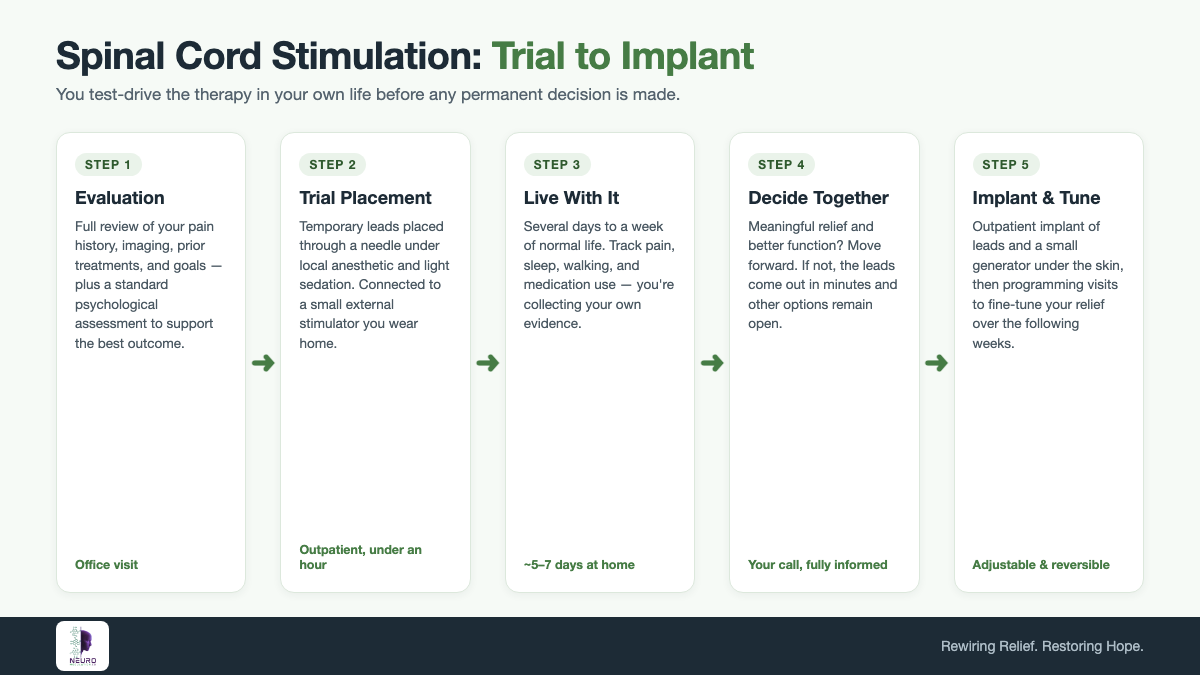
The Trial: A Test-Drive Before Any Commitment
Here’s the feature of spinal cord stimulation that I believe every patient should understand first: you try it before you decide.
During a trial, temporary leads are placed through a needle in an outpatient procedure — local anesthetic, light sedation, typically under an hour. The leads connect to a small external stimulator taped to your back or worn on a belt. Then you go home and live your life for several days to about a week.
Your job during the trial is to collect evidence. Can you stand at the sink longer? Walk farther? Sleep through the night? Did you reach for medication less often? We’re looking for meaningful relief and improved function — not perfection. If the trial succeeds, you have real, personal evidence the therapy works for you before any implant. If it doesn’t, the leads come out in minutes, there’s no incision to heal from the leads, and you’ve lost almost nothing. In my experience, that try-before-you-buy structure is unique among surgical pain treatments, and patients find it deeply reassuring.
Curious whether a trial makes sense for you?
The first step is a conversation and a careful review of your history.
The Implant Procedure and Recovery
If the trial earns its keep, the permanent implant is a minimally invasive outpatient procedure, usually about one to two hours. Permanent leads are placed (through a needle or, in some cases, a small incision for a paddle-style lead), and the pulse generator is tucked into a pocket under the skin. Most patients go home the same day.
Recovery is mostly about letting the leads settle into place. For several weeks, we ask you to avoid bending, twisting, lifting, and reaching overhead — the “BLT rules,” as patients memorably shorten them (bending, lifting, twisting). Incision soreness typically fades over a week or two. After the healing period, the real work begins: programming. Your device representative and physician fine-tune the stimulation over several visits to match your pain pattern. This tuning phase matters enormously — a well-programmed system and a poorly programmed one can feel like entirely different therapies.
Who Does Spinal Cord Stimulation Help?
Spinal cord stimulation is generally considered after conservative treatments haven’t delivered lasting relief. The conditions where it’s most established include:
- Persistent pain after spine surgery — often labeled failed back surgery syndrome. The hardware did its job, the fusion healed, and yet the leg or back pain remains. This is historically the most common reason patients come to me for SCS.
- Painful diabetic neuropathy — burning feet and legs from diabetes-related nerve damage. This has become one of the fastest-growing uses of the therapy; we cover it in detail on our SCS for diabetic neuropathy page.
- Complex regional pain syndrome (CRPS) — severe, often limb-based pain that outlasts and outscales its original injury.
- Other neuropathic pain — nerve injury pain, radiculopathy that isn’t a surgical candidate, and select cases of peripheral neuropathy from other causes.
Studies over several decades have shown that many well-selected patients experience substantial, durable relief — enough to improve sleep, function, and quality of life, and often to reduce reliance on medications. I choose the word “many” deliberately: outcomes vary, selection matters, and anyone quoting you a guaranteed result is doing you a disservice. The trial exists precisely because the only percentage that matters is yours.
Who Is It Not For?
Candor requires this section. Spinal cord stimulation is generally not the right tool when:
- The pain is primarily mechanical — an unstable spine, a compressed nerve that surgery could decompress, a joint that needs replacement. Fix the mechanics first.
- Conservative care hasn’t genuinely been tried. SCS is a later chapter, not page one; see our overview of pain management alternatives for what usually comes first.
- There’s an active untreated infection, an inability to safely pause certain blood thinners, or untreated significant psychological distress — not as a judgment, but because each measurably worsens outcomes until addressed.
- Expectations can’t be aligned — a patient seeking zero pain forever will be disappointed by a therapy whose realistic promise is meaningful relief and restored function.
For a practical self-assessment, I’ve written a companion checklist: Am I a Candidate for a Spinal Cord Stimulator? 7 Signs It May Be Time.
How It Compares with Other Options
Patients often ask me to place spinal cord stimulation on the map of everything else they’ve tried or been offered. A few plain-English comparisons:
Versus long-term medications: Stimulation is targeted at the pain pathway rather than circulating through your whole body, so it avoids systemic side effects like sedation, fog, and dependence concerns. Many patients pursue SCS specifically hoping to reduce their medication burden — a goal we plan deliberately rather than promise.
Versus repeat injections: Injections can be valuable, but their relief is typically measured in weeks or months. Stimulation is designed as a durable, always-available therapy you adjust yourself.
Versus more surgery: This comparison matters most. Revision spine surgery for pain alone — without a clear structural target — has a discouraging track record. Stimulation offers a reversible, testable alternative that doesn’t burn any bridges: if it doesn’t work, your other options remain.
Versus peripheral nerve stimulation: When pain lives in one specific nerve’s territory, placing a lead at that nerve may make more sense than at the spinal cord. The right answer depends on your pain map — literally where it is and which nerves serve it.
Living with a Stimulator: The Unglamorous Details
A few practical realities patients appreciate knowing in advance. Rechargeable systems need regular charging sessions — typically a wearable paddle over the battery site while you read or watch TV. You’ll carry a controller and learn your programs. Airport security is manageable with a device ID card. Driving while actively adjusting stimulation is discouraged, just as you wouldn’t text and drive.
MRI deserves its own mention: many modern systems are MRI-conditional, meaning scans are possible under specific protocols, but this varies by device, body region, and scanner — it’s a standard part of device selection, especially if you have conditions likely to need future imaging. And like any implanted device, complications are possible: infection (highest in the early weeks), lead migration that shifts coverage, discomfort over the battery, and the eventual need for battery replacement. These are uncommon enough that the therapy’s risk profile is considered favorable among surgical options, and common enough that you deserve to hear them before consenting — not after.

Frequently Asked Questions
Does getting a spinal cord stimulator hurt?
The trial and implant are done with local anesthetic and sedation; most patients report pressure rather than pain during placement, and soreness at the incision sites for a week or two afterward. The stimulation itself should never hurt — if it ever does, it needs reprogramming, and you can always turn it off yourself.
How long does a spinal cord stimulator last?
The leads are designed to stay in place indefinitely. Battery life depends on the system: rechargeable generators are generally designed to last many years before replacement, while non-rechargeable batteries are replaced in a minor procedure when depleted, on a timeline that depends on your usage and settings. Your device team monitors this at follow-ups — it’s not something you have to track alone.
Can a spinal cord stimulator be removed?
Yes. The system can be turned off any time, and surgically removed if you ever want or need that. This reversibility is one of the therapy’s defining advantages over fusion and other structural surgeries, and it’s a large part of why the trial-first pathway exists.
Will I feel the device under my skin?
You’ll likely be able to feel the generator’s outline if you press over it, much like a pacemaker, and awareness of it typically fades with time. Generator placement is planned around your body and habits — which side you sleep on, where your waistband sits — during the pre-implant discussion.
The Bottom Line
Spinal cord stimulation is not a cure for chronic pain, and I’d never present it as one. It is a well-established, testable, adjustable, largely reversible therapy that has given many of my patients their lives back when little else had — and it has the rare decency to prove itself in a trial before asking for a commitment. If your pain has outlasted surgery, medications, and patience, it’s worth a serious conversation.
This article is educational only and is not medical advice. Individual results vary, and nothing here replaces an in-person evaluation with a licensed physician. Please consult your own healthcare provider about your specific situation.
Take the first step toward answers.
Schedule a consultation to find out whether spinal cord stimulation fits your situation.
— Dr. Erika Petersen, MD, FAANS, FACS, is a board-certified neurosurgeon specializing in neuromodulation and a past president of the American Society of Pain & Neuroscience. Connect with her on LinkedIn.