
DRG stimulation is one of the most important refinements in modern neuromodulation, and it’s also one of the most misunderstood. Patients arrive in my clinic having read that it’s “like a spinal cord stimulator, but better,” which is both almost right and importantly wrong. As a neurosurgeon who implants both systems, I want to lay out the real differences — where they sit in the body, how they’re placed, what pain each one suits, and how we choose between them — in plain English.
If you haven’t yet read my overview of how spinal cord stimulation works, it’s a useful companion to this article. Here, I’ll assume the basics and focus on the comparison.
First, a Quick Map of the Nervous System
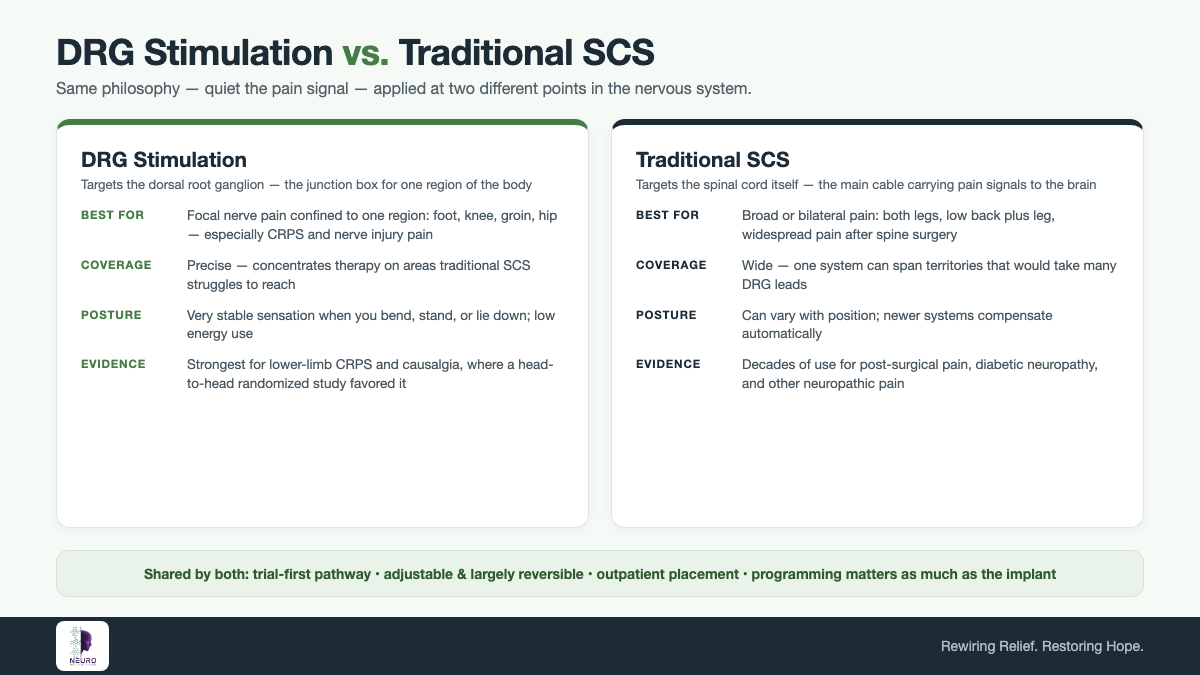
Your spinal cord is the main cable carrying pain signals from the body to the brain. Traditional spinal cord stimulation (SCS) places thin leads in the epidural space along the back of that cable, delivering mild electrical pulses that quiet pain signals as they travel upward. It’s a broad tool, well suited to pain that covers larger territories — both legs, the low back, widespread nerve pain after spine surgery.
The dorsal root ganglion — the “DRG” — is different. At every level of your spine, just outside the spinal cord, sits a small cluster of nerve cell bodies that acts as a junction box for sensation from one specific region of the body. Every pain signal from that region passes through its ganglion before entering the spinal cord. A DRG lead sits directly at that junction box, targeting the exact neighborhood where your pain lives rather than the whole highway.
DRG Stimulation vs. SCS: The Core Difference Is Targeting
That anatomical difference drives everything else. Think of traditional SCS as adjusting the volume on a whole sound system, while the DRG approach adjusts one instrument’s microphone. Neither approach is “better” in the abstract — the right choice depends entirely on the map of your pain.
Traditional SCS shines when pain is broad or involves the trunk and both limbs. DRG stimulation shines when pain is focal and stubbornly confined to one region — a foot, a knee, a groin, a hip — especially when that pain is neuropathic, meaning driven by nerve injury or nerve malfunction rather than ongoing tissue damage. If the distinction between nerve pain and other pain is new to you, our primer on neuropathic pain explains it.
Where DRG Stimulation Has the Strongest Evidence
The conditions with the best-established case for DRG stimulation are complex regional pain syndrome (CRPS) and causalgia — severe nerve injury pain — of the lower limbs. In a large randomized study comparing the two therapies head to head in these patients, DRG stimulation outperformed traditional spinal cord stimulation, and that evidence is the basis of its FDA approval in the United States. You can read background on CRPS itself from the National Institute of Neurological Disorders and Stroke at ninds.nih.gov, and the study is indexed at PubMed.
Beyond CRPS, physicians use ganglion-level stimulation for other focal neuropathic pain — post-hernia groin pain, nerve injury after knee or foot surgery, phantom limb pain — based on growing but less definitive evidence. I’m candid with patients about that distinction: for lower-limb CRPS, the comparative data are strong; elsewhere, we’re applying sound reasoning and accumulating experience, and the trial-first pathway protects you either way.
Not sure which therapy fits your pain map?
That’s exactly the question a consultation is for.
Five Key Differences, Side by Side
1. Target. Traditional SCS stimulates the spinal cord itself, influencing broad territories. A DRG system targets one or more specific ganglia, each serving a defined patch of the body.
2. Precision versus coverage. DRG stimulation can concentrate therapy on areas that traditional SCS historically struggles to cover well — the foot, the groin, the knee. Traditional SCS covers wide or bilateral pain patterns that would require many DRG leads to match.
3. Energy and positional stability. The DRG sits in a snug bony pocket with very little of the fluid that surrounds the spinal cord, so a DRG system typically requires far less energy, and the sensation tends not to change when you bend, stand, or lie down. Traditional SCS stimulation can vary with posture, though newer systems compensate automatically.
4. Placement technique. Both are placed through needles in the epidural space, but steering a lead into the ganglion’s pocket is a more intricate maneuver than laying leads along the midline. In experienced hands both are routine outpatient procedures; it’s reasonable to ask any physician how often they perform each.
5. Feel of the therapy. Both therapies can be programmed so that many patients feel little or no tingling. When stimulation is perceptible, DRG patients typically feel it confined to the painful region, while traditional SCS paresthesia can cover broader areas.
What’s the Same Between the Two
It’s worth being equally clear about what doesn’t differ. Both are forms of neuromodulation with a trial-first pathway — you test either therapy with temporary leads for about a week before any implant, exactly as described in my step-by-step guide to the trial. Both use an implanted pulse generator and a patient controller. Both are adjustable and largely reversible — they can be turned off or removed. Both carry the same honest caveats: infection risk, lead movement, the need for programming visits, and the reality that outcomes vary. And neither repairs the underlying injury; both change how pain signals are processed. For nerve-driven chronic pain, that faulty signal processing often is the disease — but you should hear what the therapy does and doesn’t do before consenting, not after.
How I Choose Between Them in Practice
The decision usually comes down to three questions. First, where exactly is your pain? I ask patients to shade a body diagram. A focal patch in one limb points toward the ganglion-level approach; broad, bilateral, or axial back pain points toward traditional SCS or other options on the spinal cord stimulation spectrum. Second, what’s driving it? Focal neuropathic diagnoses — CRPS, nerve injury, post-surgical nerve pain — favor the ganglion-level approach. Third, what does your anatomy and history allow? Prior spine surgery at the target level, certain deformities, and imaging-compatibility needs all enter the conversation.
Sometimes the honest answer is that either could work, and occasionally we trial one and learn from your body’s response that the other is the better tool. That is not failure — that is the process working. If you’re earlier in this journey and wondering whether any stimulator is appropriate, start with the candidacy checklist.
Procedure, Recovery, and Daily Life with Either System
Whichever therapy fits your pain map, the practical experience is similar enough to describe once. The trial placement is an outpatient procedure under local anesthetic and light sedation, typically under an hour. If the trial earns its keep, the permanent implant is another outpatient procedure: leads are placed, and a small pulse generator — patients call it “the battery” — is tucked under the skin, usually in the upper buttock or flank.
Recovery is mostly about letting the leads settle. For several weeks you’ll avoid bending, lifting, twisting, and reaching overhead while scar tissue anchors everything in place. Incision soreness fades over a week or two. Then comes the phase patients underestimate: programming. Over several visits, your physician and device representative tune the stimulation to your pain pattern. A well-programmed system and a poorly programmed one can feel like entirely different therapies — this is true for both approaches, and it’s why choosing a team that stays engaged after the implant matters as much as the implant itself.
Day to day, you’ll carry a controller, learn your programs, and — with rechargeable generators — spend some regular time charging through the skin with a wearable paddle. Airport security is manageable with a device ID card. MRI compatibility varies by device, body region, and scanner, so if you have a condition likely to need future imaging, say so during device selection; it genuinely influences the choice of system.
Questions Worth Asking at Your Consultation
- Which therapy fits my pain map, and why? The answer should reference where your pain is, not just what device is newest.
- How many of each system have you placed? Experience with the specific technique is a fair and important question.
- What would a successful trial look like for me? Agree on the yardstick — specific activities, sleep, medication use — before the trial starts.
- What are my options if the first choice doesn’t deliver? Good neuromodulation care has a plan B, and it should be discussed before plan A begins.
Frequently Asked Questions
Is DRG stimulation better than spinal cord stimulation?
For focal lower-limb CRPS and causalgia, comparative evidence favors the DRG approach. For broad, bilateral, or back-dominant pain, traditional SCS is usually the better tool. “Better” only has meaning relative to your specific pain map — which is why the evaluation matters more than the brochure.
Does DRG stimulation require a trial first?
Yes. Like traditional SCS, it follows a trial-first pathway: temporary leads for several days to a week, an external stimulator, and a decision made on your own evidence before anything is implanted.
Is the DRG procedure riskier than a standard stimulator?
The risk profiles are broadly similar — infection, lead movement, soreness over the battery — with the main difference being that ganglion lead placement is more technically intricate. Choosing a physician experienced with the specific system matters, and you should feel free to ask about that experience directly.
Can DRG stimulation help back pain?
Generally it is not the first choice for broad low back pain; its strength is focal limb and regional pain. Back-dominant pain is usually better served by traditional or newer forms of SCS, and occasionally by other approaches entirely — another reason an individualized evaluation beats a generic recommendation.
The Bottom Line
DRG stimulation and traditional spinal cord stimulation are siblings, not rivals: the same philosophy of quieting pain signals with mild electrical pulses, applied at two different points in the nervous system. The spinal cord approach covers broad territories; the ganglion approach concentrates therapy on one stubborn region. Matching the tool to your pain map — and proving the match in a trial before any commitment — is what good neuromodulation care looks like.
— Dr. Erika Petersen, MD, FAANS, FACS, is a board-certified neurosurgeon specializing in neuromodulation and a past president of the American Society of Pain & Neuroscience. Connect with her on LinkedIn.
This article is educational only and is not medical advice. Individual results vary, and nothing here replaces an in-person evaluation with a licensed physician. Please consult your own healthcare provider about your specific situation.
Bring us your pain map.
Schedule a consultation to find out which therapy — if either — fits your situation.