
Spinal cord stimulator recovery is the part of this journey my patients ask about most once a successful trial is behind them. They’ve seen what the therapy can do for a week; now they want to know what the permanent implant will ask of them in return. As a neurosurgeon who has spent her career in neuromodulation, I can tell you the honest answer: a few weeks of patience, a handful of temporary rules, and a steady return to the life you’ve been waiting to get back. Here is how that usually unfolds, week by week.
If you’re earlier in the process, you may want to start with my guide to how spinal cord stimulation works or the step-by-step walkthrough of the spinal cord stimulator trial. This article picks up on the day of the permanent implant and follows you through the first few months. (And if the whole field is new to you, What Is Neuromodulation? covers the fundamentals.) One note before we begin: every surgeon’s protocol differs slightly, so treat this as a general map of spinal cord stimulator recovery, and treat your own surgical team’s instructions as the final word.
First, a Quick Picture of What Was Implanted
Understanding the hardware makes the recovery rules make sense. A permanent system has two parts. The leads — thin, flexible wires with electrical contacts — sit in the epidural space near the spinal cord, in roughly the same position that worked during your trial. The generator, a small battery-powered device about the size of a stopwatch or smaller, sits under the skin, most often in the upper buttock, flank, or lower abdomen. A thin extension or the lead itself tunnels under the skin to connect the two.
Most of what you’ll do in the first two months is about one goal: letting your body build a little scar tissue around the leads so they stay exactly where we placed them. Leads that shift early can change where you feel stimulation, and sometimes they need a revision. That’s why the movement rules matter more than the incisions themselves.
Day of Surgery and the First 48 Hours
The permanent implant is usually done as an outpatient procedure or with a short overnight stay, depending on your surgeon, the type of lead used, and your overall health. You’ll have two incisions: one along the spine where the leads were anchored, and one where the generator was placed. Both are closed with sutures, staples, or surgical glue under a dressing.
Expect real incisional soreness for the first couple of days — more than you felt after the trial, because this time there were actual incisions. Patients often describe the generator pocket as the more tender of the two. Ice packs over the dressing (not directly on the skin), short-term pain medication as prescribed, and rest are the main tools. Before you leave, the device representative or clinical team will usually turn the stimulator on and set a starting program, so you go home with therapy already running.
- Have a driver and a helper. You won’t drive home, and an extra pair of hands for the first few days makes the rules much easier to follow.
- Keep the dressing dry. Follow your surgeon’s specific instructions on when showering is allowed.
- Walk a little, often. Gentle short walks around the house help circulation and stiffness. Walking is encouraged; bending is not.
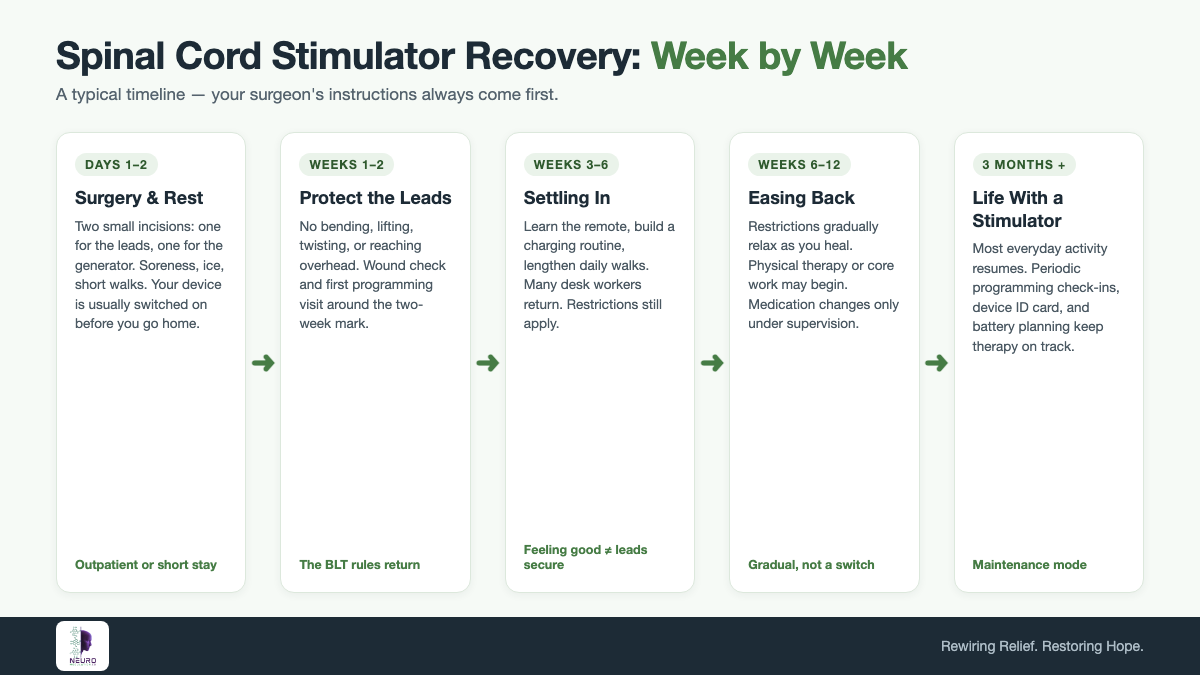
Spinal Cord Stimulator Recovery: Weeks 1–2
The first two weeks are the “protect the leads” phase, and they’re where spinal cord stimulator recovery asks the most of you. The familiar trial rules return, usually with a little more emphasis:
- No bending, lifting, or twisting (the BLT rules). Bend at the knees if you must pick something up, and keep lifting to very light objects — your surgeon will give you a specific weight limit.
- No reaching overhead. Raising your arms above your head stretches the spine in a way that can tug on fresh leads. Move frequently used items to counter height before surgery.
- No driving for the period your surgeon specifies, typically at least until you’re off sedating pain medication and can move comfortably.
- Sleep comfortably. Many patients find sleeping on their back or the side opposite the generator easiest at first.
Somewhere around ten days to two weeks, you’ll typically have a wound check, and any sutures or staples that need removing come out. This is also a common point for a first programming follow-up. If the stimulation isn’t covering your pain the way it did during your trial, tell us. Early adjustments are routine and expected — the device has many settings, and finding your best one can take a few visits.
Planning ahead for your implant?
A consultation is the right place to map out your recovery around work and family.
Weeks 3–6: Settling In and Finding Your Program
By the third week, the incisional soreness has usually faded to occasional tenderness, and most patients feel noticeably more like themselves. This is when spinal cord stimulator recovery shifts from wound healing to learning to live with your device.
The movement restrictions generally remain in place through this window, because the scar tissue that anchors the leads is still forming. It’s the most common point where patients feel well enough to start breaking rules — please don’t. Feeling good is a sign the therapy is working, not a sign the leads are secure.
This is a productive period for other reasons:
- Learning the remote. You’ll become comfortable changing programs, adjusting intensity, and turning the device on and off. Some systems pair with a smartphone app.
- Charging routines. If you have a rechargeable generator, you’ll settle into a charging habit — often a short session every day or every few days, depending on the device and your settings. Non-rechargeable systems skip this step but will eventually need a generator replacement procedure.
- Returning to desk work. Many patients with seated jobs return within the first few weeks, sometimes with modified hours. Physically demanding jobs usually need a longer runway.
- Gradual walking. Lengthening your daily walks is one of the best things you can do for your back, your mood, and your sleep.
Weeks 6–12: Easing Back Toward Normal Activity
Somewhere around six to eight weeks, many surgeons begin to relax the restrictions, based on how you’re healing and how the leads look. This is not a switch that flips on a particular day; it’s a gradual widening of what you’re allowed to do. Your surgeon may clear you to start a structured physical therapy or core-strengthening program, return to light household work, and resume most daily activities.
For many patients, the period between two and three months is where the real payoff of spinal cord stimulator recovery becomes visible. Activities that were impossible before — standing through a meal, walking through a store, sleeping through the night — start to feel ordinary again. I encourage patients to keep the same kind of diary they kept during the trial. It’s remarkably easy to forget how limited you were, and seeing the progress on paper is motivating.
It’s also when we often revisit medications. Some patients find they need less pain medication than before. Any changes to your prescriptions should be made slowly and under your prescribing physician’s supervision — never on your own.
Three Months and Beyond: Life With a Stimulator
After roughly three months, the active phase of spinal cord stimulator recovery is generally behind you, and most patients are cleared for their full range of everyday activity, including more vigorous exercise. Life with a stimulator from here on is mostly about maintenance:
- Periodic programming check-ins. Pain changes over time, and your settings may need updating. New programs are often a visit away.
- Telling every provider about your device. Carry your device ID card. MRI compatibility depends on your specific system, and certain procedures such as diathermy are generally prohibited with implanted stimulators.
- Airport security. Show your card and ask for a manual screening if needed; many devices have guidance for walk-through and body scanners.
- Battery planning. Every generator eventually needs replacing. That procedure is usually much simpler than the original implant because only the generator pocket is opened.
The overwhelming majority of daily life — working, traveling, exercising, playing with grandchildren — is compatible with a well-functioning stimulator. That’s the point of all of this.
Questions about life after your implant?
We’ll walk through recovery, programming, and long-term care with you.
Warning Signs to Call About Right Away
Complications after a permanent implant are uncommon, but knowing what to watch for protects your result. Call your surgical team promptly if you notice:
- Signs of infection — increasing redness, warmth, swelling, or drainage at either incision, or a fever.
- Fluid collecting around the generator pocket, or a pocket that becomes increasingly painful rather than gradually better.
- A sudden change in stimulation — coverage moving to a different area, disappearing, or becoming uncomfortable. This can signal lead movement.
- New weakness, numbness, or problems with bladder or bowel control — these need urgent attention.
- A severe headache that worsens when you sit or stand up, which can occasionally indicate a spinal fluid leak.
None of these is common, and most are treatable when caught early. When in doubt, call — no surgeon minds a call that turns out to be nothing. For broader background on chronic pain and its management, MedlinePlus maintains a helpful patient resource at medlineplus.gov.
My Practical Tips for a Smoother Recovery
- Prepare your home before surgery. Move daily items to waist height, set up a comfortable chair you can get out of easily, and stock easy meals.
- Use a grabber tool. It’s the single most useful purchase for honoring the no-bending rule.
- Plan your first two weeks off. Even desk workers benefit from a real break before returning.
- Bring your questions to programming visits. Write down when your pain is worst and what you were doing; that detail helps us fine-tune your settings.
- Stay connected to the rest of your care. A stimulator works best alongside movement, sleep, and the other strategies in our overview of pain management alternatives.
Frequently Asked Questions
How long is spinal cord stimulator recovery?
Most patients feel the incisions settle within two to three weeks, while the movement restrictions that protect the leads typically last around six to eight weeks. Many people are back to their full range of normal activities by about three months, though your surgeon will set your exact timeline.
When can I go back to work after a spinal cord stimulator implant?
It depends on your job. Desk-based workers often return within the first few weeks, sometimes part-time at first. Jobs that involve lifting, bending, or overhead work usually require waiting until restrictions are lifted. We plan this together before surgery.
Will the stimulator feel the same as it did during my trial?
Often it’s similar, because we aim to place the permanent leads in the same position that worked during your trial. That said, programming usually needs a few adjustments in the early weeks as swelling resolves and the leads settle.
Can I exercise after recovery?
Yes. Once your surgeon clears you, regular exercise is encouraged. Walking is usually welcome early; core strengthening, swimming, and more vigorous activity come later. Ask before resuming high-impact sports or activities with extreme spinal twisting.
The Bottom Line
Spinal cord stimulator recovery is a short season of patience in exchange for what is, for many well-selected patients, a much longer season of better function. Follow the rules for the first couple of months, show up for your programming visits, and report anything unusual early. If you’re still weighing whether this therapy fits your situation, my checklist on who makes a good spinal cord stimulator candidate is a good next read — and a consultation is the best one.
— Dr. Erika Petersen, MD, FAANS, FACS, is a board-certified neurosurgeon specializing in neuromodulation and a past president of the American Society of Pain & Neuroscience. Connect with her on LinkedIn.
This article is educational only and is not medical advice. Recovery timelines and restrictions vary by patient, device, and surgeon, and nothing here replaces the instructions of your own surgical team. Please consult your own healthcare provider about your specific situation.
Ready to talk about your next step?
Schedule a consultation and get answers specific to your situation.