
Many of my patients arrive having already tried electrical stimulation for their pain — usually a small TENS unit from a pharmacy, a physical therapist’s office, or an online store. So when I bring up spinal cord stimulation, a natural question follows: “Isn’t that just a stronger version of the TENS unit I already have?” The answer is no, and understanding why is the heart of the TENS vs spinal cord stimulator comparison. As a neurosurgeon specializing in neuromodulation, I’ll explain how the two differ, what each does well, and how to tell when an over-the-counter device has taken you as far as it can.
If you’re new to the broader field, my plain-English overview What Is Neuromodulation? is a helpful starting point. Both TENS and spinal cord stimulation belong to that family of therapies — but they sit at very different ends of it.
What a TENS Unit Is and How It Works
TENS stands for transcutaneous electrical nerve stimulation. “Transcutaneous” means “through the skin,” and that’s the key to understanding it. A TENS unit is a small, battery-powered device connected by wires to adhesive pads that you place on the skin near your painful area. When you switch it on, it sends mild electrical pulses through the skin to the nerves underneath, usually producing a buzzing or tingling sensation.
The traditional explanation for why TENS can help draws on the “gate control” idea of pain: stimulating non-painful sensory nerves can, in effect, crowd out some pain signals traveling through the same pathways. Some settings may also encourage the body’s own pain-relieving chemistry. In practice, many people find TENS soothing while it’s running, and some notice relief that lingers for a while afterward.
Its strengths are real:
- Accessible. Many units are available without a prescription and cost relatively little.
- Non-invasive. No needles, no procedure, no recovery.
- Low risk. The most common problem is skin irritation from the pads.
- Under your control. You decide when to use it and can stop at any time.
Its limitations are just as real. The electrical signal has to pass through skin, fat, and muscle, so it reaches only relatively superficial nerves near the pads. Relief is often limited to the time you’re wearing it. Pads must be repositioned and replaced, and wearing a device with wires all day isn’t practical for most people. Research on TENS for chronic pain has produced mixed results, and its benefit varies widely from person to person.
What a Spinal Cord Stimulator Is and How It Works
A spinal cord stimulator works on the same broad principle — electrical signals that change how pain is processed — but it delivers them in a fundamentally different place. Thin leads are placed in the epidural space, right next to the spinal cord, where pain signals from large regions of the body converge on their way to the brain. A small implanted generator under the skin powers the system, and you control it with a handheld remote or app.
Because the stimulation is delivered directly at the spinal cord rather than through layers of tissue, it can influence pain signals from an entire region — both legs, the low back, or an arm — with precision that surface stimulation can’t match. Modern systems also offer stimulation patterns that many patients feel as a gentle tingle, and some that are designed to produce little or no sensation at all. I explain this in depth in Spinal Cord Stimulation: How It Works and Who It Helps.
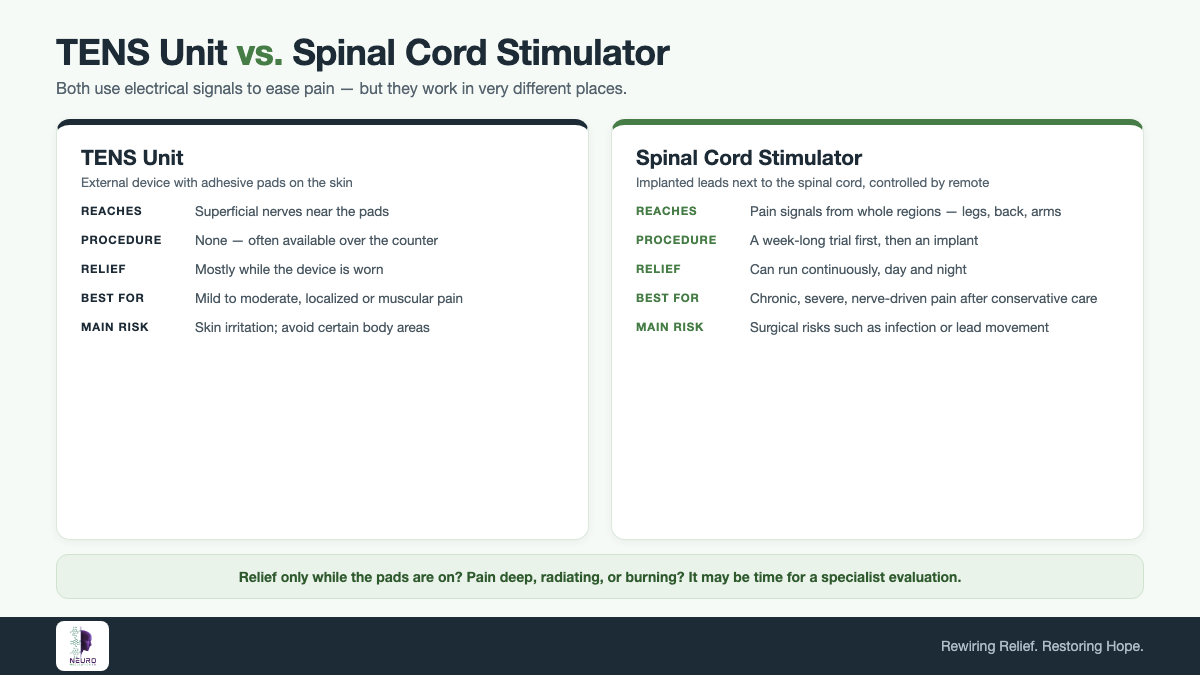
TENS vs Spinal Cord Stimulator: A Side-by-Side Comparison
Here’s how the TENS vs spinal cord stimulator comparison plays out across the factors patients ask me about most:
| Factor | TENS Unit | Spinal Cord Stimulator |
|---|---|---|
| Where stimulation happens | On the skin, near the painful area | Next to the spinal cord, inside the body |
| Procedure required | None | A trial, then an implant procedure |
| When it works | Mostly while worn | Can run continuously, day and night |
| Best suited for | Mild to moderate, often localized or muscular pain | Chronic, severe, often nerve-driven pain that hasn’t responded to other care |
| Physician involvement | Optional, though guidance helps | Specialist evaluation, implant, and ongoing programming |
| Main risks | Skin irritation; not for use over certain areas or with some implanted devices | Surgical risks such as infection, lead movement, and rarely bleeding or nerve injury |
Neither is “better” in the abstract. They’re tools for different jobs. A TENS unit is a reasonable, low-risk thing to try early; a spinal cord stimulator is a specialist therapy for pain that has proven stubborn.
Has your TENS unit stopped being enough?
Let’s talk about what the next step could look like for you.
Cost, Commitment, and Daily Life
Beyond how each device works, the TENS vs spinal cord stimulator decision involves very different levels of commitment, and it’s worth being clear-eyed about them.
With a TENS unit, the commitment is minimal. You buy or borrow a device, learn where to place the pads, and use it when you choose. The ongoing costs are mainly replacement pads and batteries. If it doesn’t help, you put it in a drawer. The trade-off is that you’re responsible for the whole process, and the device is visible and wired while you use it, which limits when and where it’s practical.
With a spinal cord stimulator, the commitment is larger but so is the potential payoff for the right patient. There’s a specialist evaluation, a psychological assessment, a trial week, and — if the trial succeeds — an implant procedure followed by several weeks of activity restrictions while the leads settle. After that, the system is largely invisible. There are no pads to place or wires to manage; you adjust therapy with a small remote, charge the device periodically if it’s rechargeable, and return for occasional programming visits. Many patients describe forgetting about the device for long stretches of the day.
That’s the practical heart of the TENS vs spinal cord stimulator trade-off: low effort and limited reach on one side, more up-front commitment and deeper, continuous therapy on the other. Which makes sense depends on how severe your pain is, what’s causing it, and how much of your life it has taken.
When Over-the-Counter Isn’t Enough: Signs It’s Time to Talk
The TENS vs spinal cord stimulator question usually becomes practical when a patient notices one or more of these patterns:
- Relief stops when the pads come off. If you feel better only while the device is running and can’t realistically wear it all day, you’re managing symptoms rather than changing your situation.
- The pain is deep or widespread. Pain radiating down a leg, pain in both legs, or pain that originates from nerve roots is often beyond the reach of skin-level stimulation.
- The pain is nerve-driven. Burning, electric, or shooting pain — the hallmarks of neuropathic pain — often responds poorly to surface devices and medications alike.
- You’ve exhausted conservative care. Physical therapy, appropriate medications, and injections have been tried without lasting improvement.
- Pain is shrinking your life. Sleep, work, relationships, and activities are steadily disappearing despite everything you’ve tried.
None of these automatically means you need an implant. They mean it’s worth an evaluation with a specialist who can look at the whole picture. My practical checklist, Am I a Candidate for a Spinal Cord Stimulator?, goes through the criteria in detail.
The Trial: The Bridge Between the Two
One reassuring point in the TENS vs spinal cord stimulator decision is that you don’t have to leap straight from a drugstore device to a permanent implant. Spinal cord stimulation always begins with a trial: temporary leads are placed through a needle, connected to an external stimulator, and worn for about a week at home. You track your pain, sleep, activity, and medication use. If the trial clearly helps, a permanent system can be discussed. If it doesn’t, the leads come out in minutes, and nothing has been implanted.
That trial is the honest test of whether deeper stimulation helps your pain in a way surface stimulation couldn’t. I walk through it step by step in The Spinal Cord Stimulator Trial: What Actually Happens.
Using TENS Safely in the Meantime
If a TENS unit is helping you, there’s no reason to abandon it while you explore other options. A few safety basics apply:
- Don’t place pads over the front or sides of the neck, over the eyes, on broken or irritated skin, or across the chest.
- If you have a pacemaker, defibrillator, or another implanted electrical device — including a spinal cord stimulator — ask your physician before using TENS.
- Ask your doctor first if you’re pregnant, have epilepsy, or have a heart condition.
- Don’t use it while driving, operating machinery, sleeping, or in the bath or shower.
- Start at a low intensity, and stop if the stimulation becomes uncomfortable or your skin reacts.
For broader, trustworthy information on living with and treating chronic pain, MedlinePlus offers an excellent patient resource at medlineplus.gov.

Frequently Asked Questions
Is a spinal cord stimulator just a stronger TENS unit?
No. Both use electrical stimulation, but a TENS unit works through the skin on nearby nerves, while a spinal cord stimulator delivers signals directly at the spinal cord, where pain signals from large regions of the body are processed. The difference in location changes what each can do.
If TENS didn’t help me, will a spinal cord stimulator also fail?
Not necessarily. Because the two work at different levels of the nervous system, a poor response to TENS doesn’t predict a poor response to spinal cord stimulation. The trial week is how we find out for your specific pain.
Can I use a TENS unit if I have a spinal cord stimulator?
Ask your physician and device team before doing so. External electrical stimulation can potentially interact with implanted devices, and the guidance depends on your specific system.
Does insurance cover spinal cord stimulation?
Many insurance plans, including Medicare, cover spinal cord stimulation for appropriate conditions when criteria are met, usually including a documented history of failed conservative care, a psychological evaluation, and a successful trial. Coverage details vary by plan.
The Bottom Line
The TENS vs spinal cord stimulator comparison isn’t a contest — it’s a progression. A TENS unit is a sensible, low-risk early tool, and for some people it’s enough. When pain is deep, nerve-driven, and has outlasted conservative care, stimulation delivered at the spinal cord may reach what surface pads cannot. If you’ve reached that point, the next step isn’t a bigger drugstore device; it’s a conversation with a specialist and, if appropriate, a trial. Either way, you deserve a plan built around your pain, not around whatever device happens to be on a store shelf.
— Dr. Erika Petersen, MD, FAANS, FACS, is a board-certified neurosurgeon specializing in neuromodulation and a past president of the American Society of Pain & Neuroscience. Connect with her on LinkedIn.
This article is educational only and is not medical advice. Individual results vary, and nothing here replaces an in-person evaluation with a licensed physician. Please consult your own healthcare provider about your specific situation.
Ready to explore what comes after TENS?
Schedule a consultation and get answers specific to your situation.