
What is neuromodulation? It’s the question I’m asked most often in clinic, usually by someone who has just heard the word for the first time from a surgeon, a friend, or a late-night internet search. In plain English, neuromodulation is a family of therapies that use gentle, targeted electrical signals — or in some cases precisely delivered medication — to change how your nervous system sends and processes pain. Instead of masking pain with a pill that travels through your whole body, we work directly with the nerves that are carrying the pain message itself.
I’m Dr. Erika Petersen, a board-certified neurosurgeon, and a large part of my career has been devoted to nerve stimulation therapy. In this guide, I want to walk you through what neuromodulation actually is, how it works, who it tends to help, and what the journey looks like — without the device-industry jargon that makes this field harder to understand than it needs to be.
What Is Neuromodulation? The Short Answer
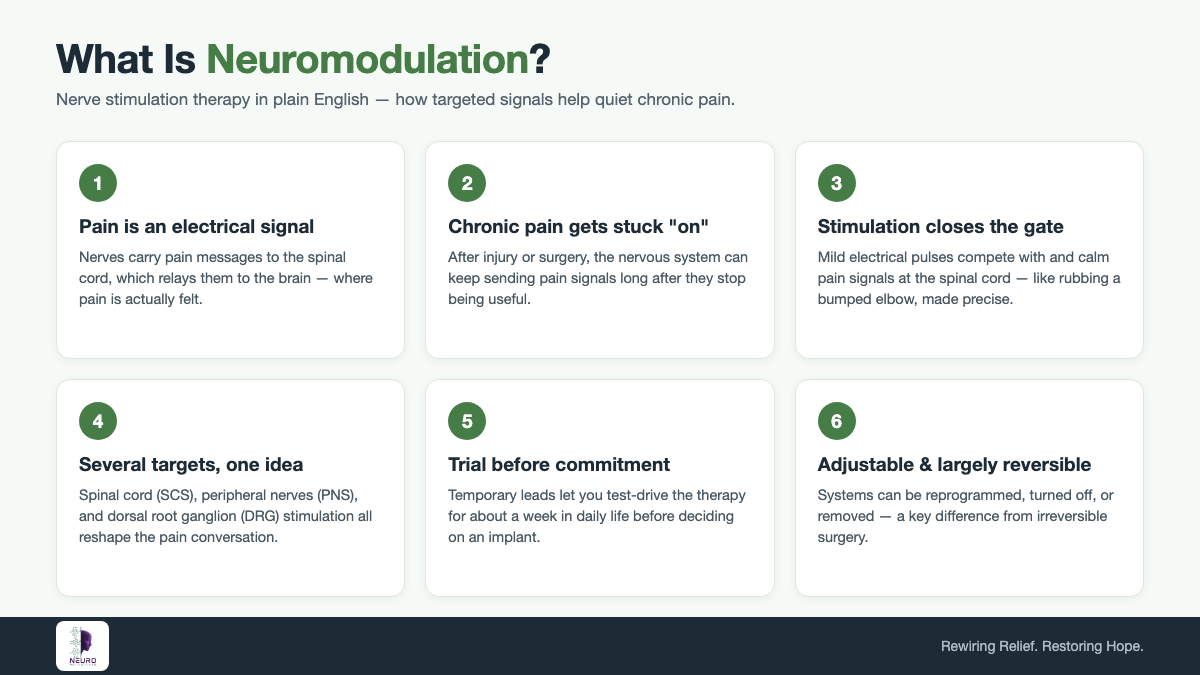
Neuromodulation means “changing nerve activity.” That’s really it. Your nervous system is an electrical communication network: nerves carry signals from your body to your spinal cord, and your spinal cord relays them up to your brain, where pain is actually experienced. When that system is working well, pain is useful — it warns you to pull your hand off a hot stove.
Chronic pain is different. After an injury, surgery, or nerve damage, the system can get stuck in a loop, sending pain messages long after they’ve stopped serving any protective purpose. Neuromodulation therapy intervenes in that loop. A small implanted or external device delivers mild electrical pulses to specific nerves, the spinal cord, or even areas of the brain, with the goal of quieting or reshaping those pain signals before they’re fully experienced.
A helpful analogy I use with patients: if chronic pain is static blaring from a radio, medications try to make the whole room quieter. Neuromodulation reaches for the tuning dial.
How Nerve Stimulation Therapy Changes Pain Signals
The scientific foundation goes back decades to what researchers called the “gate control” theory of pain. The simplified version: your spinal cord acts like a gate for pain messages traveling to the brain. Other kinds of nerve signals — like touch, vibration, or mild electrical stimulation — can compete with pain signals at that gate and partially close it.
You’ve experienced this yourself. When you bang your elbow and instinctively rub it, the rubbing genuinely does reduce the pain, because the touch signals are crowding out some of the pain signals. Nerve stimulation therapy applies that same principle in a far more precise, durable, and adjustable way.
Modern systems have grown more sophisticated than the original “replace pain with tingling” approach. Some deliver patterns of stimulation you can’t feel at all, designed to calm overactive nerve circuits rather than simply compete with them. The engineering details vary by device and manufacturer, but the shared idea is the same: intercept and modify the pain conversation between your body and your brain.
The Main Types of Neuromodulation
Neuromodulation is an umbrella term, and several distinct therapies live under it. These are the ones patients ask me about most:
Spinal cord stimulation (SCS)
The workhorse of pain-focused neuromodulation. Thin, soft wires called leads are placed in the epidural space near the spinal cord, connected to a small implanted generator — think of it as a pacemaker for pain. I cover this therapy in depth in my companion article, Spinal Cord Stimulation: How It Works and Who It Helps, and you can also explore our detailed spinal cord stimulation treatment page.
Peripheral nerve stimulation (PNS)
Instead of targeting the spinal cord, PNS places a small lead near a specific peripheral nerve — say, a nerve in the shoulder, knee, or the back of the head — when pain is confined to one nerve’s territory. Our peripheral nerve stimulation guide goes deeper on this option.
Dorsal root ganglion (DRG) stimulation
A cousin of SCS that targets the dorsal root ganglion, a cluster of nerve cells where sensory nerves enter the spine. It allows very focused coverage for pain in specific regions like the foot or groin, and is often discussed for complex regional pain syndrome (CRPS).
Other forms you may hear about
Vagus nerve stimulation, sacral nerve stimulation (used mostly for bladder and bowel control issues), and deep brain stimulation (best known for Parkinson’s disease) are all neuromodulation too. They show how broad this field is, but for chronic pain, SCS, PNS, and DRG stimulation are the therapies most patients will actually be evaluated for.
Wondering which therapy fits your situation?
A consultation is the only reliable way to match a treatment to your specific pain. We’re happy to talk it through.
Who Might Benefit from Neuromodulation?
Nerve stimulation therapy is not a first-line treatment, and I’d be skeptical of anyone who presents it that way. It’s typically considered when more conservative approaches — physical therapy, medications, injections, time — haven’t delivered lasting relief. The conditions where I most often see it considered include:
- Persistent pain after back or neck surgery, sometimes called failed back surgery syndrome — the operation healed, but the pain stayed.
- Neuropathic pain — burning, shooting, electric pain from damaged or malfunctioning nerves, including painful diabetic neuropathy.
- Complex regional pain syndrome (CRPS) — a disproportionate, often limb-based pain condition that can follow injury or surgery.
- Chronic limb pain where surgery isn’t an option or hasn’t helped.
Notice a pattern: these are mostly nerve-driven pain problems. Neuromodulation tends to perform best when the nervous system itself is the troublemaker, rather than, say, an unstable joint that needs mechanical repair.
What the Evidence Suggests — Honestly
I want to be careful here, because patients deserve straight talk rather than brochure language. Studies over several decades have shown that many well-selected patients experience meaningful, durable pain relief with spinal cord stimulation and related therapies — enough relief to sleep better, move more, and in many cases reduce reliance on pain medications.
But “many” is not “all.” Some patients get dramatic relief, some get partial relief, and some get little benefit. Results depend heavily on choosing the right patient, the right diagnosis, and the right therapy — which is exactly why the field builds a trial period into the process. No ethical physician can promise you a specific percentage of improvement, and I won’t do that here. What I can say, after a career in this field, is that for the right candidate, neuromodulation can be genuinely life-changing in a way few other chronic pain treatments are.
What to Expect: The Trial-First Pathway
One of the things I appreciate most about this field is that, for spinal cord stimulation in particular, you get to test-drive the therapy before committing to it. The typical pathway looks like this:
- Evaluation. A thorough review of your pain history, imaging, prior treatments, and goals. A psychological evaluation is standard — not because anyone doubts your pain, but because chronic pain and mood are deeply intertwined, and preparation improves outcomes.
- Trial. Temporary leads are placed through a needle — no incision for the leads themselves — and connected to a small external battery you wear for several days to about a week. You live your normal life and keep notes: How’s your pain? Your sleep? Your walking?
- Decision. If the trial meaningfully helps — the common benchmark is substantial relief and improved function — you and your physician discuss moving forward. If it doesn’t help, the leads are simply removed in a few minutes, and you’ve lost very little.
- Implant. A minor outpatient procedure places permanent leads and a small generator under the skin. Recovery restrictions are temporary, and the system is adjusted over the following weeks.
If you’re wondering whether you might be a fit for this pathway, I’ve written a practical companion piece: Am I a Candidate for a Spinal Cord Stimulator? 7 Signs It May Be Time.
Risks, Limitations, and Fair Caveats
Every medical therapy has trade-offs, and neuromodulation is no exception. Risks of implanted systems include infection, lead movement that changes stimulation coverage, discomfort at the battery site, and the possibility of needing revision procedures over the device’s lifespan. Stimulation can lose effectiveness over time in some patients, and devices eventually need battery replacement or recharging depending on the model.
There are also practical considerations: some systems have MRI restrictions (many modern ones are MRI-conditional, meaning scans are possible under specific conditions), and you’ll have a relationship with your device — charging it, adjusting programs, attending follow-ups. None of these are reasons to avoid the therapy; they’re reasons to go in with clear eyes. A good physician will walk through all of them before you decide anything. If you’re still exploring more conservative routes first, our overview of pain management alternatives is a reasonable place to start.
Have questions about your own pain?
Bring them to a real conversation. An evaluation costs you an hour — and may change your options entirely.
Frequently Asked Questions
Is neuromodulation the same thing as a TENS unit?
They’re relatives, not twins. A TENS unit stimulates nerves through pads on the skin and works only while it’s on, with fairly shallow reach. Implanted neuromodulation delivers stimulation directly at the spinal cord or nerve, continuously and adjustably, with far more precise targeting. Many patients who got brief relief from TENS are curious whether implanted therapy would do more — that’s a reasonable question to bring to an evaluation.
Does nerve stimulation hurt?
Traditional stimulation produces a gentle tingling sensation called paresthesia, which most patients describe as neutral or even pleasant once it’s tuned properly. Many newer stimulation modes are designed to be completely imperceptible — you feel the pain relief, not the stimulation. The procedures themselves are done with local anesthetic and sedation, and most patients tolerate them well.
Is neuromodulation reversible?
Largely, yes — and this is one of its most reassuring features. The trial uses temporary leads that are simply withdrawn if the therapy doesn’t help. Even a permanent implant can be turned off, reprogrammed, or surgically removed if needed. Compare that with spinal fusion, which cannot be undone, and you can see why many patients explore stimulation before considering further surgery.
Will neuromodulation get me off pain medications?
I won’t promise that, because it varies. Many patients are able to reduce their reliance on medications after successful therapy, and some discontinue certain medications entirely — but this should be a planned, physician-guided process, never an expectation that creates pressure. Relief, function, and quality of life are the primary goals; medication reduction is often a welcome byproduct.
A Word Before You Go
So, what is neuromodulation? It’s the most direct conversation medicine knows how to have with a nervous system that’s stuck shouting. It isn’t magic, it isn’t for everyone, and it should never be the first thing you try. But if you’ve worked through conservative care and your pain is still running your life, nerve stimulation therapy deserves a place on your list of options — ideally discussed with a physician who will tell you honestly whether you’re a good fit.
This article is for educational purposes only and is not medical advice. It does not replace an evaluation by a licensed physician who can examine you and review your history. Always consult your own healthcare provider before making treatment decisions.
Ready to find out what’s possible?
Schedule a consultation and get answers specific to you.
— Dr. Erika Petersen, MD, FAANS, FACS, is a board-certified neurosurgeon specializing in neuromodulation and a past president of the American Society of Pain & Neuroscience. Connect with her on LinkedIn.