
Some of the most meaningful conversations I have with patients aren’t about pain scores at all. They’re about medication — the pill bottles that have quietly multiplied over the years, the fog, the constipation, the worry about dependence, and the sense that the medicine is no longer working the way it once did. Neuromodulation opioid reduction is a topic I care about deeply as a neurosurgeon, because for many well-selected patients, stimulation therapy opens a door to needing less medication while living more fully. In this article I’ll explain how that works, what the research does and doesn’t show, and how to approach it safely.
If neuromodulation is new to you, my overview What Is Neuromodulation? explains the fundamentals. Here, I’ll focus on the specific relationship between stimulation therapies and opioid use.
Why Opioids So Often Become the Default
Opioids remain powerful medicines for short-term severe pain — after surgery or a serious injury, for example. The trouble begins when pain becomes chronic. Many patients with long-standing back pain, nerve pain, or pain after spine surgery end up on opioid medication for months or years, often because other options weren’t offered or didn’t work.
Over time, several problems tend to appear:
- Tolerance. The same dose provides less relief, which can lead to dose increases.
- Physical dependence. The body adapts, so stopping suddenly can cause withdrawal symptoms.
- Side effects. Constipation, drowsiness, mental fog, hormonal changes, and sleep-disordered breathing are common complaints.
- Increased pain sensitivity. In some patients, long-term opioid use can make the nervous system more sensitive to pain, a phenomenon called opioid-induced hyperalgesia.
- Serious risks. Higher doses and combinations with sedatives increase the risk of misuse, addiction, and overdose.
None of this is a moral failing. Patients who take opioids as prescribed for chronic pain are doing what they were told to do. But the limitations are real, and many patients come to me hoping for an approach that doesn’t depend so heavily on medication. MedlinePlus has a clear, balanced overview of opioid risks at medlineplus.gov.
How Neuromodulation Works Differently From Medication
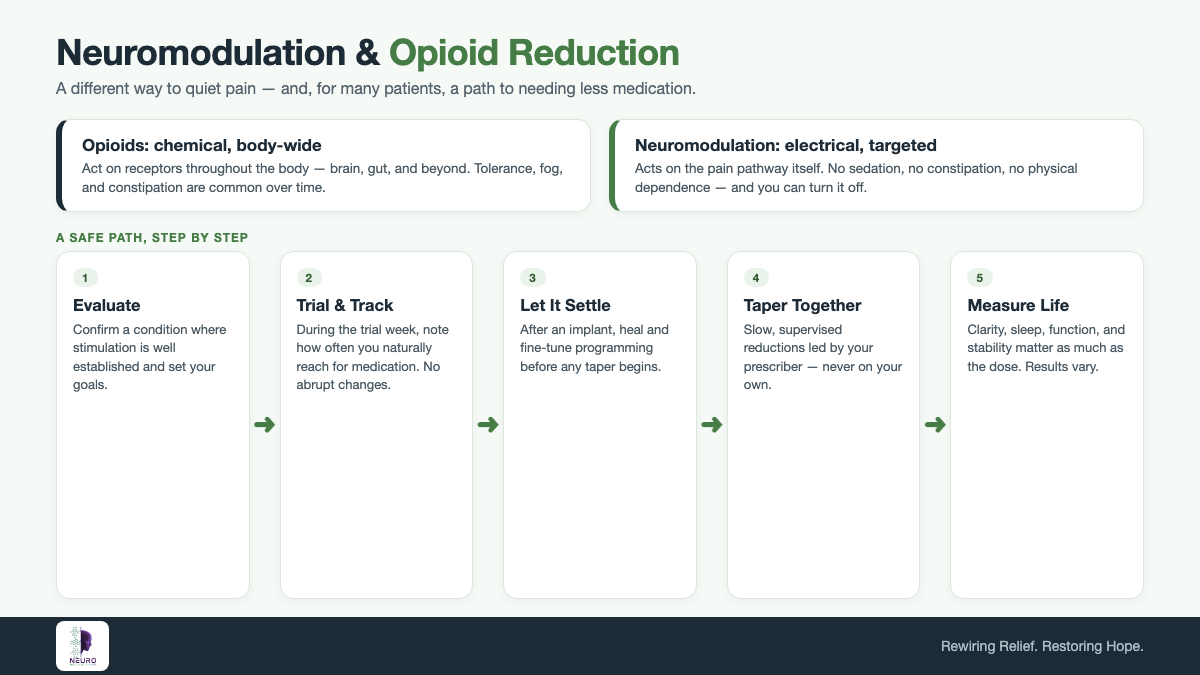
Opioids work chemically, throughout the whole body. They bind to receptors in the brain, spinal cord, gut, and elsewhere — which is why they cause side effects far from the source of pain. Neuromodulation works electrically and locally. A spinal cord stimulator, for example, delivers mild electrical signals through thin leads placed near the spinal cord, changing how pain signals are processed before they reach the brain. Peripheral nerve stimulation does something similar at a specific nerve.
That difference is the foundation of neuromodulation opioid reduction. Because stimulation targets the pathway carrying the pain rather than flooding the entire body with a drug, it doesn’t cause sedation, constipation, or mental fog. It doesn’t create the same kind of physical dependence. And for nerve-driven (neuropathic) pain in particular — which often responds poorly to opioids in the first place — it addresses the problem more directly. I explain the mechanism in detail in Spinal Cord Stimulation: How It Works and Who It Helps, and the more localized approach in Peripheral Nerve Stimulation: Targeted Relief for Localized Nerve Pain.
Neuromodulation Opioid Reduction: What the Evidence Shows
I want to be careful and honest here, because this topic attracts exaggerated claims. Here’s what I can say with confidence:
- Medication use is a routine outcome in stimulation research. Clinical studies of spinal cord stimulation commonly track opioid use alongside pain and function, and a number of them have reported that many patients were able to reduce or stabilize their opioid doses after implantation.
- Timing may matter. Some research suggests that patients who receive stimulation earlier in their pain journey, before opioid doses have climbed very high, may have better results — though the research here is still evolving.
- Results vary. Some patients reduce their medication substantially, some reduce it modestly, and some don’t change it at all. Stimulation is not a guaranteed path off opioids.
- Function matters as much as dose. Even when the dose doesn’t change much, patients who gain the ability to walk, sleep, and work more often describe a meaningful improvement in quality of life.
I won’t quote you a percentage, because the honest truth is that the numbers vary by study, condition, device, and patient population. What I will tell you is that neuromodulation opioid reduction is a realistic goal to discuss for many patients, and the trial week gives you a personal preview of whether it’s achievable for you.
Hoping to rely less on pain medication?
Let’s talk about whether neuromodulation could be part of your plan.
The Trial Week as a Medication Preview
One of the most useful parts of the stimulator trial is what it reveals about your medication needs. During the week with temporary leads, I ask patients to record not only their pain and activity but also how often they reach for pain medication. For some, the change is striking: they notice they simply needed less to get through the day. For others, there’s little change.
That information is invaluable. It’s real, personal evidence about how your body responds — collected before any permanent decision. It also sets realistic expectations for the months after an implant. I walk through the whole process in The Spinal Cord Stimulator Trial: What Actually Happens, Step by Step.
One important caution: the trial week is not the time to stop medications on your own. Abrupt changes can trigger withdrawal and confuse the results. Note what you naturally use, and leave any deliberate changes for later, under supervision.
Tapering Safely After an Implant
If you and your physicians decide to reduce opioids after a successful implant, the guiding principle is simple: slowly, collaboratively, and never abruptly. A thoughtful taper usually looks like this:
- Wait for the therapy to settle. The first weeks after an implant involve surgical healing and programming adjustments. Most tapers begin once the stimulation is consistently helping.
- Coordinate with your prescriber. Whoever prescribes your opioid medication should lead the taper, with input from your neuromodulation team.
- Go gradually. Small reductions spaced over weeks or months let your body adjust and reduce withdrawal symptoms.
- Optimize programming along the way. If pain rises during a taper, a stimulation adjustment may help before any medication change is reversed.
- Support the whole person. Sleep, mood, physical activity, and pain psychology all influence how a taper goes.
Patients sometimes worry that a successful implant means being taken off medication against their will. That isn’t how good care works. Some patients choose to stay on a stable, lower dose; others prefer to keep their current dose while they focus on rebuilding activity first. Both can be reasonable, and the plan can change as you do. Any neuromodulation opioid reduction plan should be a shared decision that respects your comfort, safety, and goals.
Other Neuromodulation Options That Can Reduce Medication Burden
Spinal cord stimulation is the most widely used option, but it’s not the only one:
- Dorsal root ganglion (DRG) stimulation targets specific nerve structures for focal pain in areas like the foot, knee, or groin.
- Peripheral nerve stimulation targets an individual nerve for localized pain and may be less invasive.
- Targeted drug delivery, sometimes called an intrathecal pain pump, delivers very small doses of medication directly to the spinal fluid. Because the medicine goes straight to where it acts, it can provide relief with a tiny fraction of the oral dose, which may reduce body-wide side effects for appropriate patients.
Each has its own candidacy criteria and trade-offs. Our overview of pain management alternatives places them alongside the non-implant options as well.
Who Is Most Likely to Benefit
In my experience, patients who are good candidates for neuromodulation opioid reduction often share some features: chronic pain with a significant nerve-related component, a condition for which stimulation is well established (such as persistent pain after spine surgery, complex regional pain syndrome, or painful diabetic neuropathy), pain that hasn’t responded adequately to conservative care, and a genuine motivation to rely less on medication. A psychological evaluation and realistic expectations are part of every assessment.
What Success Looks Like Beyond the Pill Count
It’s tempting to measure neuromodulation opioid reduction by a single number: milligrams before versus milligrams after. That number matters, but in my practice it’s never the whole story. When I review how a patient is doing months after an implant, I look at a broader picture:
- Clarity. Do you feel more alert and present with your family and at work?
- Function. Can you walk farther, stand longer, or return to activities you’d given up?
- Sleep. Are you sleeping through more nights?
- Side effects. Has constipation, drowsiness, or fog eased?
- Stability. Has the upward creep in dosing stopped, even if the dose hasn’t fallen dramatically?
A patient who holds a modest dose steady for years while getting back to work and sleeping well has had a real success. So has a patient who tapers off entirely. Defining success together, before we start, keeps the goals honest and keeps any neuromodulation opioid reduction effort focused on what genuinely improves your life rather than on a number alone.

Frequently Asked Questions
Will a spinal cord stimulator let me stop taking opioids?
Some patients are able to reduce or stop opioids after stimulation, and others are not. Results vary by person and condition. The trial week gives you a realistic preview, and any reduction should be planned with your prescriber.
Do I have to stop opioids before getting a stimulator?
Not usually. Many patients are evaluated and trialed while on their usual medication. Some physicians may recommend reducing very high doses beforehand, but this is individualized and should never be done abruptly.
Is neuromodulation addictive?
No. Electrical stimulation doesn’t act on the brain’s reward pathways the way opioids do, and it doesn’t cause physical dependence or withdrawal. You can turn it off at any time.
What if my pain increases while tapering?
Tell your care team. A programming adjustment, a slower taper, or additional support may help. A taper should feel manageable, not punishing.
The Bottom Line
Opioids have a place in medicine, but for many people with chronic pain they become a heavy and diminishing tool. Neuromodulation offers a fundamentally different approach, working on the pain pathway itself without the body-wide side effects of medication. Neuromodulation opioid reduction isn’t guaranteed, but for many well-selected patients it’s a realistic and worthwhile goal — pursued gradually, safely, and together with the physicians who know you.
— Dr. Erika Petersen, MD, FAANS, FACS, is a board-certified neurosurgeon specializing in neuromodulation and a past president of the American Society of Pain & Neuroscience. Connect with her on LinkedIn.
This article is educational only and is not medical advice. Never stop or change an opioid medication without guidance from your prescribing physician. Individual results vary, and nothing here replaces an in-person evaluation with a licensed physician. If you or someone you know is struggling with opioid use, please speak with your healthcare provider promptly.
Ready to explore a different approach to pain?
Schedule a consultation and get answers specific to your situation.