
Peripheral nerve stimulation is the quietest success story in my field. Spinal cord stimulators get most of the attention — understandably, since they’ve been around for decades — but for a certain kind of patient, the one whose pain lives in a single nerve’s territory, placing a small lead directly at that nerve is often the more elegant answer. As a neurosurgeon specializing in neuromodulation, I want to explain what this therapy is, who it genuinely helps, and how it differs from its better-known sibling — in plain English, with the caveats included.
If you’re new to this entire family of treatments, my overview What Is Neuromodulation? is the right starting point. For the deepest dive on this specific therapy, we also maintain a comprehensive guide to peripheral nerve stimulation; this article is the shorter, patient-to-physician conversation version.
What Is Peripheral Nerve Stimulation?
Peripheral nerve stimulation (PNS) delivers mild electrical pulses to a specific peripheral nerve — a nerve outside the spinal cord — to quiet pain signals at their source. A thin, flexible lead is placed through a needle, under ultrasound guidance, next to the nerve responsible for your pain. The lead connects to a small pulse generator, which in some systems is implanted under the skin and in others is a miniature device worn externally, with only the tiny lead inside the body.
The logic is simple: if your pain comes from one identifiable nerve — a nerve injured in surgery, trapped in scar tissue, or damaged by trauma — then treating that one nerve directly makes more sense than treating the entire spinal cord. Think of it as fixing the one streetlight that’s flickering rather than rewiring the whole grid.
A useful piece of background: every peripheral nerve serves a predictable territory of skin and tissue, mapped in detail over more than a century of anatomy. When a patient traces their pain along the outside of the shoulder, or across the top of the foot, or up the back of the scalp, they are often unknowingly drawing a nerve’s territory for me. That’s why I pay such close attention to exactly where your pain lives — the map is frequently the diagnosis, and the diagnosis determines whether a single, reachable nerve is the true generator of your pain.
How It Differs from Spinal Cord Stimulation
Both therapies belong to the same family and share the same philosophy: use carefully shaped electrical pulses to change how pain signals are transmitted, rather than numbing the body or sedating the mind. The difference is address. Spinal cord stimulation works at the main cable, influencing broad territories — both legs, the low back, widespread nerve pain. The peripheral approach works at a single branch line, influencing one nerve’s specific territory — the outside of one shoulder, the front of one knee, a patch of one foot, one side of the head.
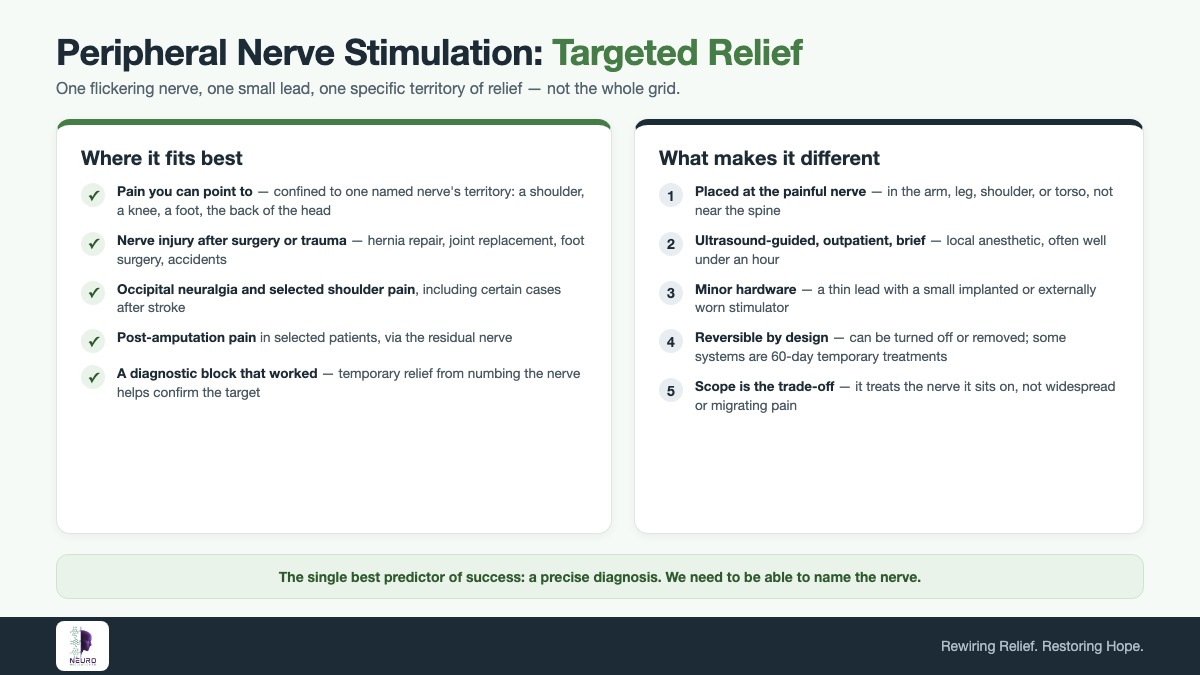
That difference has practical consequences. A peripheral lead is typically placed in the arm, leg, shoulder, or torso rather than near the spine, which many patients find reassuring. The procedure is commonly done under ultrasound rather than X-ray. And because the target is small and close, the energy requirements are modest. The trade-off is scope: a peripheral system treats the nerve it sits on. If your pain is broad, migrating, or involves multiple regions, this is the wrong tool, and I’ll say so.
Who Peripheral Nerve Stimulation Helps Most
The common thread in good candidates is pain confined to one named nerve’s territory — what we call a focal mononeuropathy. The situations where I most often reach for this therapy include:
- Nerve injury after surgery or trauma — pain in the territory of a nerve injured during hernia repair, knee replacement, foot surgery, or an accident.
- Nerve entrapment pain that persists after release surgery or isn’t a surgical candidate.
- Shoulder pain in selected patients, including certain cases after stroke, via nerves serving the shoulder.
- Occipital neuralgia — pain in the territory of the occipital nerves at the back of the head.
- Post-amputation pain, where stimulation of the residual nerve can address stump and phantom limb pain in selected patients.
- Selected cases of neuropathic pain where the generator of the pain can be traced to one accessible nerve.
Notice the hedging words — “selected,” “certain cases.” They’re deliberate. Many well-selected patients experience meaningful, durable relief with peripheral nerve stimulation; poorly selected patients don’t, and selection is the physician’s responsibility. The single best predictor is a precise diagnosis: we need to be able to name the nerve. A diagnostic nerve block that temporarily relieves your pain is often part of building that case.
Is your pain confined to one nerve’s territory?
That question has a testable answer — and it starts with an evaluation.
What the Procedure Actually Involves
One of the appeals of this therapy is how minor the procedure is compared with most surgery. The typical sequence:
- Evaluation and nerve mapping. History, examination, and usually a diagnostic block to confirm the target nerve. We also review prior treatments — this therapy, like its siblings, comes after conservative care; see our overview of pain management alternatives for what usually comes first.
- Trial or staged placement. Depending on the system, you may have a short trial with a temporary lead before any permanent decision — the same trial-first philosophy I apply across neuromodulation. Some modern systems are themselves designed as sixty-day temporary treatments, with the lead removed at the end.
- Placement. Under local anesthetic, with ultrasound guidance, the lead is advanced through a needle to sit alongside the target nerve. The procedure is typically outpatient and brief, often well under an hour.
- Programming and follow-up. The stimulation is tuned to your pain over one or more visits. As with every therapy in this family, a well-programmed system and a neglected one can feel like different treatments entirely.
Recovery is modest: soreness at the site for a few days and temporary activity restrictions while the lead settles. Most patients return to ordinary activities quickly — the details depend on which nerve we’re treating and which system we’ve chosen.
The Honest Limitations
Candor is the price of your trust, so here are the limits. Peripheral nerve stimulation treats the nerve it sits on — it will not help pain that is widespread, centrally driven, or primarily mechanical. Leads near mobile joints can migrate, which may change or reduce relief and occasionally requires revision. Relief varies from person to person, and anyone quoting you a guaranteed percentage is doing you a disservice; the only percentage that matters is yours, which is exactly why trial-first pathways and staged systems exist. Infection and local discomfort are uncommon but possible with any implanted device. And the evidence base, while growing steadily, is younger than the decades of data behind spinal cord stimulation — strong for several specific uses, still maturing for others. The National Institute of Neurological Disorders and Stroke maintains excellent background on nerve pain and its treatments at ninds.nih.gov.
One more honest note on choosing a physician. Because the procedure is comparatively minor, it is offered in a widening range of settings, with a widening range of rigor. The therapy’s results depend heavily on selection — naming the right nerve, confirming it with a block, matching the right system to your anatomy and goals. Ask any physician how they confirmed your target nerve and what their plan is if the first approach disappoints. Good answers to those two questions tell you most of what you need to know.
Peripheral Nerve Stimulation vs. Your Other Options
Versus repeat nerve blocks: Blocks are valuable diagnostically and can give weeks of relief, but they wear off. Stimulation is designed as a durable therapy you adjust yourself — and a block that works is often the evidence that stimulation will have the right target.
Versus long-term medication: Stimulation acts at the painful nerve rather than circulating through your whole body, avoiding systemic effects like sedation and fog. Many patients pursue it specifically hoping to reduce their medication burden — a goal we plan deliberately rather than promise.
Versus spinal cord stimulation: If your pain fills one nerve’s territory, the peripheral approach is often the more targeted tool; if it spans regions, the spinal approach usually wins. Sometimes we genuinely debate it, and the pattern of your pain — your pain map — settles the argument.
Versus another surgery on the nerve: Re-operating on a scarred, painful nerve has mixed results. Stimulation is reversible and doesn’t burn bridges: if it fails, your other options remain.

Frequently Asked Questions
Is peripheral nerve stimulation permanent?
It doesn’t have to be. Some systems are implanted for long-term use but can be turned off or removed; others are designed as temporary sixty-day treatments with the lead removed afterward. Reversibility is one of the therapy’s defining features, and the right format depends on your diagnosis and goals.
Does peripheral nerve stimulation hurt?
Placement is done under local anesthetic and is typically well tolerated, with a few days of site soreness afterward. The stimulation itself should feel like mild tingling or nothing at all — never pain. If it ever hurts, it needs reprogramming, and you can turn it off yourself.
How is this different from a TENS unit?
A TENS unit stimulates broadly through the skin and stops working when you take it off. An implanted peripheral lead sits directly at the target nerve, delivering precise therapy continuously or on your schedule. A TENS trial that helps can be a hint, but the two are different tools of different strength.
Will insurance cover it?
Coverage varies by insurer, diagnosis, and system, and typically requires documentation that conservative care has been tried. Our team handles authorization as part of the evaluation process, so you know where you stand before anything is scheduled.
The Bottom Line
Peripheral nerve stimulation is targeted medicine in the most literal sense: one flickering nerve, one small lead, one specific territory of relief. It is not a cure, and it is the wrong tool for widespread pain — but for the patient whose pain traces to a single nameable nerve, it offers something rare: a minor, reversible, testable procedure aimed at exactly the right address. If that description sounds like your pain, the next step is a conversation and, often, a simple diagnostic block that begins to answer the question properly.
— Dr. Erika Petersen, MD, FAANS, FACS, is a board-certified neurosurgeon specializing in neuromodulation and a past president of the American Society of Pain & Neuroscience. Connect with her on LinkedIn.
This article is educational only and is not medical advice. Individual results vary, and nothing here replaces an in-person evaluation with a licensed physician. Please consult your own healthcare provider about your specific situation.
Pain you can point to deserves a therapy that aims.
Schedule a consultation to find out whether this therapy fits your situation.