
Painful diabetic neuropathy is one of the conditions closest to my heart as a researcher. For years, patients with burning, electric pain in their feet and legs were told that medications were essentially their only option, and that if those failed, they would simply have to cope. That picture has changed. In this article I’ll walk through what the evidence on spinal cord stimulation diabetic neuropathy treatment actually shows, where the research is still developing, and how to think about whether it might fit your situation.
If you’d like a deeper clinical overview of the therapy for this condition, our dedicated page on spinal cord stimulation (SCS) for diabetic neuropathy goes into more detail. Here, I want to focus on the evidence itself — what we know, how we know it, and what questions remain.
Understanding Painful Diabetic Neuropathy
Diabetic neuropathy is nerve damage caused by diabetes. Over time, elevated blood sugar can injure nerves and the small blood vessels that nourish them. The most common form, peripheral neuropathy, usually begins in the feet and can gradually move up the legs and, in some people, into the hands. The National Institute of Diabetes and Digestive and Kidney Diseases provides a clear overview of the different types and their causes.
Not everyone with diabetic neuropathy has pain. Many people mainly notice numbness. But a significant group develops painful diabetic neuropathy, which patients describe as burning, stabbing, tingling, “pins and needles,” or the sensation of walking on broken glass. It is often worse at night, and it can make sleep, walking, and working genuinely difficult.
Painful diabetic neuropathy is a type of neuropathic pain — pain that arises from the nervous system itself rather than from an injured joint or muscle. That distinction matters, because neuropathic pain often responds poorly to typical pain relievers, and it’s one of the reasons neuromodulation has drawn so much interest in this area.
Standard Treatments and Their Limits
Care for painful diabetic neuropathy usually starts with the foundations: good blood sugar control, careful foot care, regular check-ups, and attention to overall health. For pain specifically, physicians commonly prescribe medications from several classes, including certain anticonvulsants and antidepressants that calm overactive nerve signaling, along with topical treatments.
These medications help many patients. Others find that relief is partial, or that side effects such as drowsiness, dizziness, or weight changes make them hard to tolerate. Some patients try several medications in sequence, adjusting doses over months, and still struggle. Those are the people who often ask me whether there is anything else. For those patients, the question becomes whether a different kind of therapy — one that works on the nervous system directly — deserves a closer look.
How Spinal Cord Stimulation Works for Neuropathy
Spinal cord stimulation places thin leads in the space near the spinal cord and delivers gentle electrical signals that change how pain messages travel to the brain. For diabetic neuropathy, where pain typically affects the feet and lower legs, the leads are usually positioned in the lower thoracic spine, which corresponds to nerve pathways serving the lower body. I explain the general mechanism in Spinal Cord Stimulation: How It Works and Who It Helps.
An important point: stimulation is not designed to repair damaged nerves or reverse diabetes. Its main goal is to reduce pain and improve function. Patients should understand that clearly before considering it.
Living with painful diabetic neuropathy?
Let’s talk about whether stimulation could be part of your plan.
What the Spinal Cord Stimulation Diabetic Neuropathy Evidence Shows
The research base for this application has grown considerably. A few themes stand out across the spinal cord stimulation diabetic neuropathy literature:
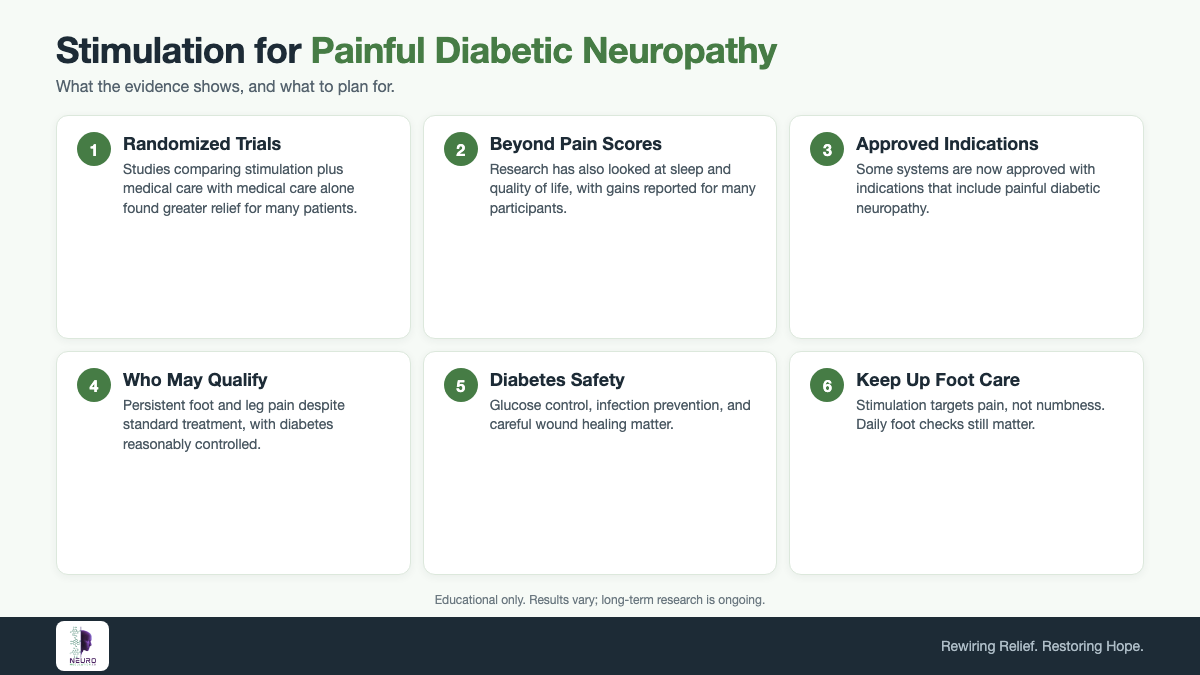
- Randomized controlled trials. Several randomized studies have compared stimulation plus conventional medical management against conventional management alone in patients whose pain persisted despite standard care. In these trials, many patients who received stimulation reported meaningfully greater pain relief than those who continued medications alone.
- Beyond pain scores. Studies have also looked at sleep, quality of life, and patients’ own sense of overall improvement, and several have reported gains in these areas for many participants.
- Regulatory recognition. In recent years, regulators have approved spinal cord stimulation systems with indications that specifically include painful diabetic neuropathy — a sign that the evidence has matured beyond small case series.
- Different waveforms. Both traditional tingling-based programs and paresthesia-free programs have been studied in this population. Research continues on which approaches suit which patients best.
I have had the privilege of researching this question directly, including leading a national clinical trial of spinal cord stimulation for painful diabetic neuropathy. That work, and the work of many colleagues, has helped move the conversation from “Does it help anyone?” to “Who is most likely to benefit, and how do we do it safely?” I won’t quote specific percentages here, because results depend on the study, the device, and the patient — and I’d rather you hear realistic expectations in a personal consultation than a number taken out of context.
Questions researchers are still exploring
Honest evidence includes its open questions. Researchers are still studying how durable relief is over many years, which patients respond best, and how stimulation compares with newer medications. Some investigators are also exploring whether stimulation could influence sensation or other neurological findings in some patients; that is an interesting area of ongoing research, not an established benefit, and I’d encourage caution with any claim that stimulation “restores” nerves.
How to read research claims you find online
If you search for spinal cord stimulation diabetic neuropathy studies, you’ll find headlines that range from cautious to breathless. A few habits help. Look for whether a study was randomized and compared stimulation with a control group. Notice how long patients were followed. Ask who was included — a trial that enrolled people with well-controlled diabetes and leg pain may not describe someone with very different health circumstances. And be wary of any source that promises a specific result for you. Research describes groups of people; your consultation is where that evidence gets translated to your own body.
Bringing printed articles or links to your appointment is welcome. Reviewing spinal cord stimulation diabetic neuropathy research together is one of the best ways to set expectations that are both hopeful and realistic.
Who May Be a Candidate
Spinal cord stimulation diabetic neuropathy candidates generally share a few characteristics. They have painful neuropathy, usually in the legs and feet, that has persisted despite reasonable trials of standard treatments. Their diabetes is reasonably well controlled. And they are healthy enough for a minimally invasive procedure. A psychological evaluation is often part of the process as well, as it is for most stimulation candidates.
The general criteria are described in detail in my checklist, Am I a Candidate for a Spinal Cord Stimulator?. For diabetes specifically, your physician will want to look closely at a few additional areas.
Diabetes-Specific Safety Considerations
People with diabetes can do very well with stimulation, but diabetes adds considerations worth discussing openly:
- Blood sugar control. Elevated glucose can impair healing and increase infection risk. Many physicians want glucose levels reasonably controlled before an implant, and your diabetes care team may be involved in planning.
- Infection and wound healing. Careful incision care matters for everyone, and especially for people with diabetes. Report redness, warmth, drainage, or fever promptly.
- Foot health. Stimulation may ease pain, but it does not replace daily foot checks. Because numbness can coexist with pain, injuries can go unnoticed. Keep up with foot care and podiatry visits.
- Other conditions. Heart, kidney, and circulation problems are common alongside diabetes and may affect procedural planning.
None of these automatically rules stimulation out. They simply mean the plan should be individualized and coordinated with the rest of your care. The MedlinePlus page on diabetic nerve problems is a useful companion resource for day-to-day self-care.
The Trial: Testing Before Committing
As with other uses of stimulation, spinal cord stimulation diabetic neuropathy treatment usually begins with a trial. Temporary leads are placed, and you spend about a week testing the therapy in your normal routine — walking, sleeping, and doing the activities your pain has limited. If the trial gives you meaningful relief and better function, a permanent implant may be discussed. If it doesn’t, the leads are removed and you’ve learned something valuable without a long-term commitment.
For people with neuropathy, I pay particular attention during the trial to sleep and walking tolerance, since those are often the areas where painful neuropathy takes its biggest toll. You can read a full walkthrough in The Spinal Cord Stimulator Trial: What Actually Happens, Step by Step.
Wondering if a trial makes sense for you?
A consultation can help you weigh the evidence against your own goals.
Frequently Asked Questions
Is spinal cord stimulation diabetic neuropathy treatment approved?
Yes. In recent years, some spinal cord stimulation systems have received regulatory approval with indications that include painful diabetic neuropathy. Your physician can explain which systems are appropriate for you and whether your insurance covers them.
Will stimulation help numbness in my feet?
Stimulation is designed mainly to relieve pain. Numbness is a different symptom, and you should not expect stimulation to restore normal sensation. Researchers are studying sensory changes, but that is not an established benefit.
Do I still need my diabetes medications and foot care?
Absolutely. Stimulation is an addition to your diabetes care, not a replacement for it. Continue blood sugar management, foot checks, and regular visits with your diabetes team.
How long does relief last?
Many patients in studies have continued to report benefit over the follow-up periods researched so far, but long-term data are still accumulating and individual results vary. Ongoing programming adjustments are part of keeping relief steady.
The Bottom Line
Painful diabetic neuropathy no longer has to be a story that ends with “there’s nothing left to try.” The evidence for spinal cord stimulation diabetic neuropathy treatment has grown into a well-studied option for carefully selected patients whose pain persists despite standard care. It isn’t a cure for diabetes or for nerve damage, and it isn’t right for everyone. But for the right person, it may offer a meaningful path back to better sleep, steadier walking, and a fuller life. If your neuropathy pain has outlasted your medications, it’s a conversation worth having.
— Dr. Erika Petersen, MD, FAANS, FACS, is a board-certified neurosurgeon specializing in neuromodulation and a past president of the American Society of Pain & Neuroscience. Connect with her on LinkedIn.
This article is educational only and is not medical advice. Individual results vary, and nothing here replaces an in-person evaluation with a licensed physician. Please consult your own healthcare provider about your specific situation, and do not change your diabetes treatment without talking to your care team.
Ready to explore your options?
Schedule a consultation and get answers specific to your situation.